F. Scott Fitzgerald
Critique • Works • Views and quotes
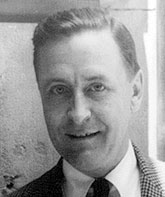 F. SCOTT FITZGERALD, 1937 (Carl Van Vechten)
Born
Saint Paul, Minnesota, U.S., 1896
Died
Hollywood, California, U.S., 1940
Forms of writing
Novels, stories, memoir, play, screenplays
Genres
Literary, autobiography
Writing language
English
Places of writing
United States, France
Literature
• Tales of the Jazz Age (1922)
• The Great Gatsby (1925)
• Tender Is the Night (1934)
Novels
• The Great Gatsby (1925)
• Tender Is the Night (1934)
Stories
• "Bernice Bobs Her Hair" (1920)
• "May Day" (1920)
• "The Curious Case of Benjamin Button" (1922)
• "The Diamond as Big as the Ritz" (1922)
• "Babylon Revisited" (1931)
Story Collections
• Tales of the Jazz Age (1922)
American Literature
• Tales of the Jazz Age (1922)
• The Great Gatsby (1925)
• Tender Is the Night (1934)
Fantasy Stories
The butterfly who became self-conscious
Before Francis Scott Fitzgerald died at age 44, he thought he was a failure. His obituaries described him as an obscure writer who never fulfilled his early promise. The second printing of The Great Gatsby sat unsold fifteen years after the book's publication.
Twenty-odd years later, Fitzgerald was universally recognized as one of the great literary figures of the century and The Great Gatsby was widely acclaimed one of the greatest novels of the modern era.
Even more surprising to Fitzgerald might be how his own life has come to represent in the public imagination the romantic rise and fall of American idealism—a favourite subject of his writing—in the first half of the twentieth century.
Fitzgerald was born in St. Paul, Minnesota, the son of a failed furniture manufacturer although the family lived well on an inheritance. He attended Princeton University, quitting in 1917 to join the army after the United States entered the First World War. During the war, he wrote a novel taking place at Princeton, The Romantic Egotist, which publishers Scribners rejected but suggested could be revised. After a rewrite it was rejected again and was rewritten again as This Side of Paradise. Finally published in 1920 by Scribners it became an immediate popular and commercial success. He married the unstable Zelda Sayre and the two became high-living celebrities during the wild years of the 1920s.
He also started to produce short stories about the young, rich, post-war generation for magazines. He coined the term the term the "Jazz Age" for the wild 1920s that his early stories chronicled. His second novel The Beautiful and Damned (1922) and his short-story compendiums, Flappers and Philosophers (1920) and Tales of the Jazz Age (1922), told the happy and sad stories of the beautiful people of that age.
His short tales of this period can be divided into three categories: ephemeral, fashionable fare such as "Bernice Bobs Her Hair" with their made-for-magazines plot twists; the more serious stories like "The Ice Palace", and "May Day" that are like embryonic novels; and the fantasy works apparently written just for fun, such as "The Diamond as Big as the Ritz" and "The Curious Case of Benjamin Button". Selections from all three types have become recognized as modern classics.
His novel The Great Gatsby (1925), though, introduced a mature tragic element, taking the story of the self-made but deluded millionaire Jay Gatsby beyond the immediate era and into the mainstream of the American dream—its myth and reality. The novel's controlled but romantic detachment however was not what the public wanted in the middle of the goodtime Roaring Twenties and, despite positive reviews, the novel was not widely appreciated.
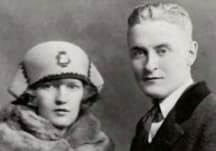
Zelda and Scott Fitzgerald
The Fitzgeralds were living in Europe among other American expatriates when he met Ernest Hemingway and, as a famous author, Fitzgerald became a promoter of the as-yet little-known writer. The two also became close friends but as Hemingway's star rose, Fitzgerald struggled with his own work.
His next novel was to be a study of Americans in France called The Boy Who Killed His Mother, or Our Type, or The World's Fair, but it never came together. As always, Fitzgerald continued to turn out magazine fiction—he wrote 160 short stories in total—to make enough money to support his lifestyle and, after Zelda's mental breakdown in 1930, to pay for her psychiatric treatment.
Before and after the publication of The Great Gatsby, he produced a number of noteworthy stories known informally as the "Gatsby cluster", sharing some of that novel's themes of wealth, social status and the loss of youthful dreams as the Jazz Age aged. The novel-like stories, "The Rich Boy" and "Winter Dreams" are among the best of these, collected in All the Sad Young Men (1926).
Despite a recovery, Zelda's mental health continued to waver over the next few years and Fitzgerald's novel, called Tender is the Night when it came out in 1934, focused on an American psychiatrist and his patient/wife living in Europe. Although it was his most ambitious work (and has since become established as one of the great novels of the century), the critics were divided over it and the public ignored it.
The stories he wrote around the novel however were appreciated by the public, if not by the critics who dismissed it as outdated, harking back to the Roaring Twenties in the midst of the Great Depression. Many were collected in Taps at Reveille (1935), including great stories like "Babylon Revisited", written in 1931 about a man trying to recover something of what he lost before the depression, as well as some of the 1928-written stories featuring Basil Duke Lee and Josephine Perry that would be posthumously collected separately as The Basil and Josephine Stories.
After the crack-up
After this, Fitzgerald's world fell apart. Alcoholism prevented him from writing commercial stories, he was deeply in debt, Zelda was committed to a mental hospital and he gave up their only child to be raised and educated by others. This period did however yield the magazine articles he wrote under the title "The Crack-Up" in 1936 in an attempt to cure himself. They were later edited by the critic Edmund Wilson into a book published after Fitzgerald's death.
A two-year stint as a Hollywood screenwriter resulted in only one screen credit but did get him out of debt. More importantly it gave him the material for a series of brilliantly cynical tales about a screenwriter's life, later collected as The Pat Hobby Stories (1962), as well as for a novel, The Last Tycoon (1941), which unfortunately was unfinished when Fitzgerald died of a heart attack.
Hemingway has been savaged as a jealous ingrate for his portrait of Fitzgerald in his memoir of the Paris years, A Moveable Feast. However, despite the picture that emerges of Fitzgerald as erratic and insecure, the love and respect Hemingway held for the slightly older writer comes through. His description of Fitzgerald to a bar chief years after Fitzgerald's death is a pretty objective summary of the man's achievements, expressed in Hemingway's usual understated manner: "He wrote two very good books and one which was not completed which those who know his writing best say would have been very good. He also wrote some good short stories."
In a more poetic vein, Hemingway introduced the Fitzgerald section of his memoir with the following:
His talent was as natural as the pattern that was made by the dust on a butterfly's wings. At one time he understood it no more than the butterfly did and he did not know when it was brushed or marred. Later he became conscious of his damaged wings and of their construction and he learned to think and could not fly any more because the love of flight was gone and he could only remember when it had been effortless.
Scott Fitzgerald's resurrection as an artist since his death and the growing recognition of The Great Gatsby and Tender Is the Night as modern masterpieces has led to many more collections of his works to be published, often under confusing titles. Babylon Revisited (1960) includes the story of the same name that originally appeared in Taps at Reveille and one other from that collection, along with classic tales from the 1920s volumes. Six Tales of the Jazz Age and Other Stories (1960) combines six from 1922's Tales of the Jazz Age with three from All the Sad Young Men—sort of the second-best of Fitzgerald.
The most comprehensive collection of stories though may be The Stories of F. Scott Fitzgerald (1951), with notes by writer and critic Malcolm Cowley and including the best stories from each period of Fitzgerald's career.
The Portable F. Scott Fitzgerald (1945) was compiled by Dorothy Parker and introduced by John O'Hara. It includes The Great Gatsby, Tender Is the Night and nine short stories. This may be the best introduction to his works as a whole, if you could find it. It's out of print but you may sight it in a used book store.
— Eric
Critique • Works • Views and quotes

