Norman Mailer
Critique • Works • Views and quotes
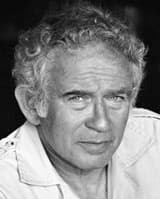
Born
1923
Died
2007
Publications
Novels, journalism, essays
Writing language
English
Literature
• The Naked and the Dead (1948)
Novels
• The Naked and the Dead (1948)
• The Executioner's Song (1980)
American Literature
• The Naked and the Dead (1948)
• The Armies of the Night (1968)
• The Executioner's Song (1980)
• Harlot's Ghost (1991)
Crime and Mystery
• The Executioner's Song (1980)
Journalism
• The Executioner's Song (1980)
Literary Fiction
• The Naked and the Dead (1948)
True Crime
• The Executioner's Song (1980)
Maybe it was all show—but what a show
I once heard the Canadian writer Morley Callaghan describe Norman Mailer as a showboat more than a writer. For Mailer is part of a post-World War II generation of U.S. writers—along with Gore Vidal, Truman Capote and others—who became known as widely for their media appearances as for their literary works.
But Mailer also produced a large and serious body of work. Will it stand the test of time as well as the works of the famous American writers from Callaghan's time earlier in the century? Mailer himself once measured himself against Ernest Hemingway, although his style turned out to be quite different.
Now that Mailer's political and literary causes have receded into the past and now that he's no longer around to keep telling us how great he is, it may be a good time to reassess his prolific work.
Mailer seems to be a writer who needs a big external cause or theme, particularly one in which he is a player, to spark his best work. He was born in New Jersey and studied at Harvard. He was drafted in 1944 and served in the Pacific during the war. He used his battle experience to create his first novel The Naked and the Dead (1948).
It became a bestseller, making him one of the first big-name American writers to emerge from the war, although he never again wrote about it.
He suffered an extended sophomore jinx with his second and third novels. Barbary Shore (1951) suffers from murkiness as his theme never really comes into focus. It's a rambling story told by an amnesiac would-be writer about life in a Brooklyn rooming house among unhinged artists and intellectuals, who may or may not be communist spies or American agents in that paranoid post-war period. The characters talk gushingly but confusingly, especially about capitalism and socialism, giving rise to the suspicion (borne out in some of his later works) that Mailer's vocabulary outstrips his actual knowledge.
The Deer Park (1955) made headlines for its sex-in-Hollywood subject but the meandering novel was also poorly received.
New journalism
Then Mailer discovered his biggest and longest lasting theme: himself. He started mixing journalism and auto-biographical musings with his fictional output, most notably in The White Negro (1957) and Advertisements for Myself (1959), the latter collection attracting attention as presaging the new personal journalism of the next decade. That title alone could sum up some critics' views of his work at that time.
During this period he was also involved in political journalism, co-founding New York's alternative newspaper, Village Voice, in 1955 and editing Dissent magazine from 1952 to 1963.
In the early 1960s he undertook to produce a novel in monthly instalments for a magazine. He began with his narrator describing a double-date with future U.S. president Jack Kennedy in 1946 and by the end of An American Dream (1964) he had completed a tour de force of sex, politics, celebrity and psychotic behaviour. The novel shows signs of hurried writing and may not be one of the highest-quality works of the day, but it is an exhilarating ride. And it seemed to rejuvenate Mailer. It was also loosely adapted for a truly awful, melodramatic movie in 1966.
Many of Mailer's works in the turbulent sixties dealt with his involvement in the anti-war protest movement. Why Are We in Vietnam? (1967) is actually a stream-of-consciousness novel about a Texas youth nicknamed D.J. on a hunting expedition and does not mention the infamous war until the memorable last two lines: "This is D.J., Disk Jockey to America turning off. Vietnam, hot dam."
The Armies of the Night (1968) reported somewhat more directly on a massive anti-war demonstration in Washington, during which Mailer was himself arrested. It's a subjective, sometimes hilarious, often insightful and always self-absorbed account of those times. His follow-up, Miami and the Siege of Chicago (1969), dealt similarly with his involvement in protests outside the Democratic and Republican conventions of 1968.
Mailer's next foray into what was coming to be known as New Journalism was Of a Fire on the Moon (1970), a psychological account of the first human lunar landing. He was developing a rapid-fire style of colliding insights and hyperbole in his "nonfiction novels" of this period:
The astronauts were the core of some magnetic human force called Americanism, Protestantism, or WASPitude... They were the knights of the Silent Majority, the WASP emerging from human history in order to take us to the stars.
He produced no fewer than ten more works in the 1970s, among which Marilyn, about screen siren Marilyn Monroe, and The Executioner's Song, profiling death-row convict Gary Gilmore, were his best received. The latter was considered a masterpiece by some and won Mailer's second Pulitzer Prize, the first having been awarded for The Armies of the Night.
The big and the silly
As his output continued into the next decade Mailer kept talking about a big work of fiction he was working on. Ancient Evenings finally appeared in 1983, a massive, messy, stream-of-consciousness novel taking place in ancient Egypt. It elicited both wild applause and disappointment.
His less ambitious Tough Guys Don't Dance from the next year, though, is a terrific novel of sex, drugs and murder. Mailer says he wrote it in sixty days and the plot is "silly". Hmm, is there a lesson in this? His less carefully thought-out novels sometimes have more life to them than his "great works".
In the 1990s his most notable works may be Harlot's Ghost (1991)—a long, often engaging novel of life in the CIA from the mid-1950s to the assassination of John F. Kennedy—and Oswald's Tale (1996) about Kennedy's alleged assassin.
Into his eighties and up to the very end his production was prodigious. In the last two years of his life, he published three more books. The Big Empty: Dialogues on Politics, Sex, God, Boxing, Morality, Myth, Poker and Bad Conscience in America (2006) is based on conversations with his 27-year-old son. On God: An Uncommon Conversation (2007) features dialogues on his concept of an artistic god. His last and acclaimed novel, The Castle in the Forest (2007) is a strange story of Hitler as a child, from the perspective of a demon who twists him into the monster he became.
It often seems that, contrary to his early literary idol, Mailer would never use a single word where sixteen would do. And he himself often seems to be the real subject of anything he wrote, whether in the first or third person.
But when his swirling, erratic ideas came together with the right theme, he could give gritty life to almost any subject matter. This showboat put on an entertaining, if erratic, show.
— Eric
Critique • Works • Views and quotes
