George Orwell
Critique • Works • Views and quotes
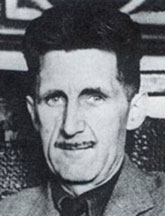
Born
1903
Died
1950
Publications
Novels, memoirs, essays, journalism
Writing language
English
Literature
• Animal Farm (1945)
• Nineteen Eighty-Four (1949)
Novels
• Nineteen Eighty-Four (1949)
Novellas
• Animal Farm (1945)
Nonfiction
• Down and Out in Paris and London (1933)
British Literature
• Keep the Apidistra Flying (1936)
• Animal Farm (1945)
• Nineteen Eighty-Four (1949)
Humour and Satire
• Animal Farm (1945)
Philosophical Fiction
• Nineteen Eighty-Four (1949)
Science Fiction
• Nineteen Eighty-Four (1949)
Utopias and Dystopias
• Nineteen Eighty-Four (1949)
Memoirs
• Down and Out in Paris and London (1933)
Travel
• Down and Out in Paris and London (1933)
The paradoxes of a political writer's life
There are two George Orwells.
The one who became posthumously famous for producing the speculative works Animal Farm and Nineteen Eighty-Four, giving the adjective "Orwellian" to totalitarian societies.
And the George Orwell who wrote gritty accounts of real life in his journalism and fiction for much of his life. These earlier works were little known by the public during his lifetime but have become influential works of literature and political thought since his death, although never as popular as his two most famous works.
Orwell's life was full of other seeming paradoxes.
Born Eric Arthur Blair in India to members of the Indian Civil Service, he was educated at Eton in Britain. He served with the Indian Imperial Police in Burma from 1922 to 1927 before leaving to live in England and France in self-imposed poverty.
His first journalistic book, Down and and Out in Paris and London (1933), is an engrossing account of his experience living among tramps, while his first novel Burmese Days (1934) hearkens back to his earlier life when he'd been a policeman.
As a socialist and like many other left-leaning writers of the day, he joined the republican forces in the Spanish Civil War where he was wounded in 1936. But unlike, say, Ernest Hemingway's fictional accounts of the conflict, Orwell's autobiographical report, Homage to Catalonia (1938), criticizes the communists. He became identified more as an anarchist, opposing centralized rule by any interests.
His next nonfictional book, The Road to Wigan Pier (1937), continues his story of impoverished life in a sympathetic study of the lives of miners in the Lancashire town of Wigan.
Three more novels published in the 1930s include A Clergyman's Daughter (1935), Keep the Aspidistra Flying (1936), and Coming Up for Air (1939).
On politics and linguistic decay
He also produced much journalism in the remaining two decades of his short life, one of the most influential articles being the essay "Politics and the English Language" (1950) which associates authoritarianism with linguistic decay. The pieces have been collected in Dickens, Dali and Others (1946), Shooting an Elephant (1950) and the four-volume Collected Essays, Journalism, and Letters of George Orwell (1968).
But his most popular works were published in his last few years. Animal Farm (1945) is a fable in which livestock overthrow the farm owner and establish a regime that starts with egalitarian ideals but becomes an oligarchy. It is usually taken as a satire on Stalinism. Nineteen Eighty-Four (1949) is one of the best-known novels of the twentieth century, as even people who have never read it know it warns of a centralized society run by Big Brother.
In the anti-red 1950s these works were heralded as attacks on socialism, but before he died Orwell denied this:
"My recent novel is NOT intended as an attack on Socialism or on the British Labour Party (of which I am a supporter) but as a show-up of the perversions to which a centralized economy is liable and which have already been partly realized in communism and Fascism. I do not believe that the kind of society I describe necessarily will arrive, but I believe (allowing of course for the fact that the book is a satire) that something resembling it could arrive. I believe also that totalitarian ideas have taken root in the minds of intellectuals everywhere, and I have tried to draw these ideas out to their logical consequences."
The two books together are the twentieth century's biggest sellers for a contemporary author. And nearly all of them have been flogged, and even assigned in high schools, where they are misread as anti-collectivist, pro-individualist screeds in the vein of Ayn Rand.
Ordinary lives
Intellectuals and journalists also read Orwell—his books and his essays—for his views on language. He's held up as a champion of the link between clear writing and liberty, the misuse of words being a tool for oppression. His prescriptions for writers are still argued about today however, with some questioning whether his rules are themselves anti-creative and thus supportive of the status quo.
But in order to appreciate Orwell's writing, it's really not important whether you agree with either Orwell's presumed political message or his actual political views—or with his linguistics. His focus really is on the experience of the person within whatever social milieu he is depicting—from the hobo communities of Europe to the British mineworkers to imagined future generations living under totalitarian rule.
Yes, he was always political and—in my view—not always correct, but Orwell's motivation for political analysis was always the wellbeing and betterment of ordinary lives.
In his brief life he produced a huge body of work to this end.
Twenty volumes of his Complete Works were published in 1998. A little more than those thin publications you read in school.
— Eric
Critique • Works • Views and quotes
See also:
Buy the book:
X (Twitter):
