
Jane Eyre
Critique • Quotes • Text • At the movies
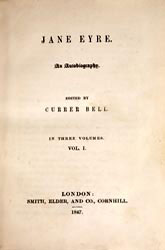 First edition title page
First publication
1847
Literature form
Novel
Genres
Literary, Gothic romance, social criticism
Writing language
English
Author's country
England
Length
Approx. 186,000 words
Strong male, stronger female
Charlotte Brontë's narrator and protagonist, like many a youthful Dickens protagonist, is the epitome of spunk. But Jane Eyre is also female, a young girl to begin with and a young woman for much of the novel. And her sex makes a big difference. Jane is slight, plain, and gentle by disposition, like any serious heroine of her time—so when she kicks back against her persecutors, as she does at least twice in the early going of Jane Eyre, it's enough to make you want to cheer. It must have been particularly surprising and refreshing for Brontë's readers in her own time.
It also wins us over to Jane as a character, and makes her boldness and independence more credible later when she finds herself in unusual situations.
If for nothing else, the novel Jane Eyre ought to be remembered for sparking this literary tradition of strong, resourceful women in this genre of—
But in which genre? I was going to say the genre of Gothic romance. But this may be taken the wrong way, along the lines of bodice-rippers, or "women's novels" or later "chick lit"—though there is some of this heightened romanticism in Jane Eyre.
Reading it for the first time, you keep thinking Jane Eyre is going in a certain direction, but then it changes. At first it seems to be a study in social realism, like Charles Dickens's or Mary Gaskell's works, exposing the hardships of a certain underclass in England at the time. But then it moves into the English tradition of the great house novel, following the inhabitants of a crumbling mansion that reflects the decline of a privileged social class. And then there's the horror story: the dark-and-stormy-night and madwoman-in-the-attic elements of the tale. And the mystical bits.
And, yes, the great romantic story in which love ultimately overcomes all. But interestingly it is love on Jane's terms.
Like her sister Emily with Wuthering Heights, Charlotte Brontë creates a powerful, darkly enigmatic and moody male at the centre of the story, but in Jane Eyre it's the male, Mr. Rochester, who is drawn to the female for her wit and intelligence and in the end it is she who saves him. Yes, perhaps this is another supposed female fantasy, that of attracting and taming the bad boy, which is certainly superior to that other stereotype of the weaker sex falling all to pieces over the macho guy who abuses her.
Sexual imagery
But Jane Eyre is not about falling for a bad person as much as about making choices based on hidden virtues, as opposed to more obvious advantages. (Note in similar fashion the unconventional love interest that the heroine of Brontë's other great work, Villette, eventually finds.) But it is also—perhaps predominantly—Rochester who recognizes something worthy in an unexpected source: our dowdy, modest and poor Jane. Surely this is what gives readers hope as we watch the relationship unfold and why we are devastated, along with Jane, when Rochester's fateful deceit is revealed—and why we are perversely relieved in the end when Jane makes the choice she does.
Much has been made about suppressed sexuality in the Brontë sisters' works. It is obvious that none of the authors, at the time of writing, were acquainted with sex to any great extent and their novels are full of substitute imagery that gives Freudians a field day. Dream sequences in Jane Eyre are particularly ripe for this analysis.
But why then are the novels still so popular in this more libertine age? If old-fashioned repressed feminine sexuality is all these books were about, only pubescent girls and unfulfilled older women would still be getting their jollies from them. But, while the Jane Eyre readership may skew toward women, it is quite wide. Even a middle-aged and moderately experienced male may still find Charlotte Brontë's novel a compelling read.
Jane Eyre appeals not just for empathy or identification with its central female character, but for appreciation. And agreement. Beneath the social covers, it's that strong.
— Eric
Critique • Quotes • Text • At the movies
See also:
Buy the book:
X (Twitter):
