
Kidnapped
Critique • Quotes • At the movies
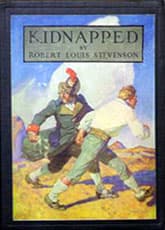 1913 edition
First publication
1886 in Young Folks magazine
First book publication
1886, England
Literature form
Novel
Genres
Literary, historical fiction, adventure, youth
Writing language
English
Author's country
England
Length
Approx. 88,000 words
Nineteenth-century thriller
In the article on John Buchan, I called his novels seminal thrillers, somewhat overshadowed by the later best-selling works of intrigue for which they showed the way. Stevenson's Kidnapped takes us back yet another generation in the action-adventure thriller genre.
Read Buchan's The Thirty-Nine Steps (1915) and Kidnapped close together, as I happened to, and you're bound to see the parallels. Both involve innocent individuals who are cast by circumstances into the middle of international intrigues and are forced to flee both villains and the law for crimes they did not commit. Moreover both heroes are Scots who play hide-and-seek with their pursuers in the heathery hills of Scotland. Buchan's debt to Stevenson is enormous.
Of course there are great differences too. Stevenson's work is morally more sophisticated, playing with an ambiguity not found in Buchan where good guys are good and bad guys are positively evil.
Young David Balfour in Kidnapped makes allies with one Alan Breck, an actual historical figure in the Jacobite rebellion supporting the claims of the Scottish royal line of Stuarts (especially the legendary "Bonnie Prince Charlie") against George II for the crown of England. David is a Lowland Scot loyal to King George, but nonetheless he comes to make common cause with the Highlander Breck who is implicated in the murder of a leading pro-George figure. People on all sides of the bloody conflict are shown as having both admirable and negative characteristics.
Throughout the novel David weaves his individual way between the two sides, as though Stevenson is saying all that political stuff is less important than the integrity of personal relations.
Enigmatic character
This is mainly an adventure story though. David is an heir but his miserly uncle has him kidnapped by sailors to be sold into slavery in North America. Before their ship can even round Scotland, we experience a collision, a sword and gun fight, and a shipwreck. The pace is swift as David and Breck try to make their way across land with British soldiers hot on their trail. It's all very exciting and suspenseful, though it is occasionally slowed by pointless conversations between the two fugitives.
If there's one fault in Kidnapped, it's Stevenson's attempt to create in Breck the kind of enigmatic character who electrifies as Long John Silver does in his Treasure Island. Breck does indeed become the liveliest personality in Kidnapped, especially compared to the pallid, goody-good David. But he remains a contradiction of loyalty and deviousness, of swashbuckling boldness and human pettiness, never rising above the contradictions to bewitch, as the famous pirate does. Breck remains annoying and admirable by turns.
The book ends rather abruptly with David regaining his rightful place (this happy ending isn't giving away anything you wouldn't have guessed) but without settling Breck's fate. The loose ends are left to the sequel Catriona (1893), often published together with Kidnapped under the title David Balfour, which is how I read them as a kid. Catriona launches David into a romance of love, an altogether different kind of story from a romance of adventure.
Kidnapped by itself though is a complete enough story that most readers are just as happy to leave it right there.
— Eric
Critique • Quotes • At the movies
See also:
Buy the book:
The Scottish Novels: Kidnapped, Catriona, The Master of Ballantrae, Weir of Hermiston
On Twitter:
