The Misanthrope
Critique • Quotes • Translations
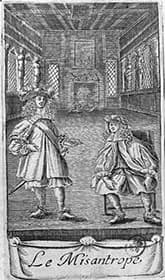 First edition frontispiece
Originally
Le Misanthrope
First performance
1666
Literature form
Play
Genres
Comedy
Writing language
French
Author's country
France
Length
Five acts, approx. 14,000 words
The critic of superficiality
The Misanthrope reads at first like one of those overheated old Russian novels in which everyone talks and talks, all very excitedly, while the action happens elsewhere. It's certainly Molière's most reflective play.
No wonder it has taken so long to become recognized as the great work it is. It doesn't include any of those audience-pleasing elements that Molière was known for, such as broad farce, bizarre characters, and justice in the end as truth triumphs over punctured pomposity.
No bizarre characters, I say? How about the misanthrope—usually defined as a hater of humanity—at the centre? Unlike other title characters in Molière's dramas, this one is not necessarily the villain or butt of the comedy. Alceste both gives and receives. He is more properly described by a secondary meaning of misanthrope—an avoider of society. Or, better, a critic of superficial society.
Alceste's own targets in this superficial society also vary. Oronte, who sues Alceste for disliking his poem, is an ass. But the flirt Célimène genuinely seems to like Alceste (and many other men!) while allowing herself to ridicule him in his absence. In the end she acts on principle in dismissing Alceste rather than sucking up to him after his criticism of her unfaithfulness (which to her is nothing to be ashamed of).
Alceste's loyal friend Philinte goes along with social convention to the point of hypocritical flattery but such compromises are portrayed as reasonable and prudent in his hands.
Telling remarks
Molière obviously is attracted by his central character's brutal honesty and flouting of convention, while at the same time he sees its sometimes pointlessness—even harm. Hence the inconclusive ending in which Alceste determines to flee society while Philinte and his lover make efforts to dissuade him.
This subtlety of characterization is the point of The Misanthrope, a true exploration of social manners. The main plot points—Alceste's court case, his suit by Oronte, the revelation of the damning letter written by Célimène—are all reported by the characters rather than shown. "Telling, not showing" is supposed to be a no-no in good writing, but in this case it works to keep the focus on the rationales of the characters.
It also makes this play, unlike other Molière works, worth reading without necessarily being seen live on stage. Also worth re-reading.
— Eric
Critique • Quotes • Translations
