Dracula
Critique • Quotes • Text • Dracula at the movies
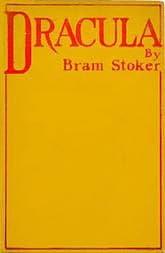 First edition
About the book
Author
Bram Stoker, England
First publication
1897
Form
Novel
Genre
Literary, fantasy
Writing language
English
Length
Approx. 180,000 words
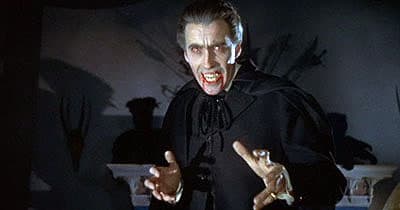
Christopher Lee's upper-crust Dracula turns appropriately red in tooth and claw.
New Dracula in the Old World
Horror of Dracula (1958): Also known as Dracula; film, 82 minutes; director Terence Fisher; writer Jimmy Sangster; featuring Christopher Lee, Peter Cushing, Michael Gough
Dracula movies have never gone out of fashion. But after Hollywood played out its Dracula-Meets-Wolf-Man-Meets-Frankenstein-Meets-Abbott-and-Costello string in the mid-1900s, the creative impetus switched to England.
In particular, the U.K-based Hammer Film Productions launched a series of horror flicks that discriminating fans swear are superior to the American efforts that had dominated the popular imagination.
Lush colour, intelligent scripts and classically trained actors are the hallmarks of these films. They are obviously produced on limited budgets and so the special effects are restrained, often implied through characters' reactions. They also tend to forgo dramatic camera tricks to present more straightforward staging with a distinctive stateliness that you get only with British film.
Plus the emphasis is placed on psychological development of characters rather than on emotional hysterics.
This is not to make the Hammer films out to be great works of arts—they are still melodramatic takes on popular cultural obsessions. But within the horror genre they are among the classiest chillers and thrillers.
Hammer's great director was Terence Fisher who worked mainly in the horror genre and made all the studio's classic flicks. Its great stars were Christopher Lee, who usually played the count, and Peter Cushing who was typically his nemesis, Van Helsing.
A right proper Dracula
In the studio's first entry, Fisher's Horror of Dracula (1958, originally named just Dracula), the title character is presented without all the Lugosi-era's gothic theatrics: no spider-webbed castle stairs or wolves howling in the night. Rather Dracula's castle is clean, tasteful and (like most Hammer sets) somewhat overlit.
The host seems a polite, reasonable sort of aristocrat. This makes his unveiling as the blood-sucking monster even scarier. For the first time on screen, the inflamed Dracula has fangs and reddened eyes. And the film doesn't forego gore either.
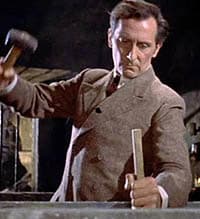
Peter Cushing as Van Helsing.
Christopher Lee's Dracula turns out to be more selfish and brutal than Lugosi's, probably closer to Bram Stoker's idea, but at the same time even more elegant.
And Peter Cushing is beyond doubt the best Van Helsing we've seen, a sophisticated, intelligent but driven man, someone you could really imagine devoting his life to the pursuit and eradication of evil. Horror of Dracula is really his movie.
Great liberties are taken with Bram Stoker's plot and characters. Harker comes to Dracula's castle somewhere in the Carpathian Mountains, not to sell him real estate but to kill him. He fails and is turned into a vampire himself before his colleague Van Helsing arrives on the scene to put him to rest. Then the drama moves to the home of Harker's fiancée Lucy and her friends the Homewoods, who are in turn stalked by the evil count.
The action never leaves eastern Europe and all the secondary characters are switched around from what we expect from the book and previous films. But these changes are smart, making the story both fresh and more believable. No wonder many call this the best Dracula ever.
He's back—with fewer theatrics but with great Brit actors as Dracula and Van Helsing.
Interestingly, although sexual desire plays a role in this Dracula, as it does in most versions, a greater analogy is drawn with drug addiction, with Van Helsing himself making a direct comparison briefly in one scene.
He's got a point. Think about it. The disease is introduced through punctures in the skin, directly into the blood system. It changes the perceptions and the drives of those infected. They become desperate to get more of the same, until the addiction progresses beyond the point of no return and the victims become the walking dead, deeply desiring to be released from their bondage but unable to stop themselves from preying on everyone around them.
Van Helsing's mission is to strike at the heart of the affliction, the head drug dealer if you will, in the person of Count Dracula.
So goes the theory of Dracula's appeal as expressing an allegory for the fear of drugs or other modern addictions taking possession of us. I'll leave it to others to sort out whether this interpretation really makes sense, but it is exemplified in the widely acclaimed Cushing-Lee Horror of Dracula.
— Eric
Critique • Quotes • Text • At the movies
1922, 1931, 1936–1945, 1958, 1960–1974, 1979, 1979–1995, 1992, 2000, 2000, 2006, 2023
