Philip José Farmer
Critique • Works • Views and quotes
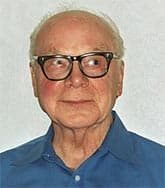 PHILIP JOSÉ FARMER, 2002 (Zacharias L.A. Nuninga)
Born
1918
Died
2009
Publications
Novels, stories
Writing language
English
Literature
• Riverworld (1971–1983)
Novels
• To Your Scattered Bodies Go (1971)
Novel Series
• Riverworld (1971–1983)
American Literature
• Riverworld (1971–1983)
Science Fiction
• Riders of the Purple Wage (1967)
• To Your Scattered Bodies Go (1971–1983)
Science Fiction Series
• World of Tiers (1965–1993)
• Riverworld (1971–1983)
On books, writers and writing
The truth is that [Kilgore] Trout, like Vonnegut and Ray Bradbury and many others, writes parables. These are set in frames which have become called, for no good reason, science fiction. A better generic term would be 'future fairy tales.' And even this is objectionable, since many science fiction stories take place in the present or the past, far and near. At least, that is the way I see Kilgore Trout's work. And that is the way I wrote this novel.
— Introduction to paperback edition of Venus on the Half-Shell, 1975
The opinions and conclusions about economics, ideology, politics, sexuality, and other matters re Homo sapiens vary according to the characters' knowledge or biases. They are not necessarily my own. I am convinced that all races have an equal mental potential and that the same spectrum of stupidity, mediocre intelligence, and genius runs through every race. All races, I'm convinced, have an equal potential for evil or good, love or hate, and saintliness or sin. I'm also convinced from sixty years of wide reading and close observation that human life has always been both savage and comically absurd but that we are not a totally unredeemable species.
— Preface to Gods of Riverworld, 1983
[Re: his impact on science fiction]
Originally, I think it was to open science fiction to a more mature treatment, a more realistic one. Since then, the impact has been on certain readers who reacted to my particular type. There are readers who don't like me, and there are others who are lukewarm, and there are others who are fanatic about it. I never really had a cult like Ray Bradbury or Frank Herbert did because I don't stick to one note. Bradbury, he had about three different themes, I think, and he repeats and repeats. But, of course, he's a great writer. I have done what I have wanted to for the moment and ranged all over the field, from adventure to deep psychology. I never made any effort to stick to one world or one set of characters. I wouldn't want a cult around me. I wouldn't have been happy. [It would have] been too confining.
— Interview with Starlog magazine, 1990
[Answering Kurt Vonnegut's complaints about Venus on the Half-Shell]
First, however, I will repeat and insist upon the fact that it was not the money I hoped to make from writing as Kilgore Trout that caused me to write the novel. It was a tribute to KV inspired because of my admiration of his works—up through KV's Breakfast of Champions. I don't care what KV says. I did it because it would be a testament of my great love for his works. And I thought it'd be a splendid idea if a book by Trout, whom everybody thought was a fictional character, did appear. Fantasy would become reality--at least for a while.
I was not burned up about KV's decision to stop me from writing sequels to VOTH-S. Actually, all I really wanted was to write Son of Jimmy Valentine, then I'd quit the Trout thing. I was not burned up; I was saddened. But, after all, Trout was KV's character. And I was lucky to and delighted to have written VOTH-S.
— "Philip José Farmer on Kurt Vonnegut & Kilgore Trout", c. 1999
See also:
Buy the book:
Riverworld: To Your Scattered Bodies Go, The Fabulous Riverboat
The World of Tiers: The Maker of Universes, The Gates of Creation, A Private Cosmos
X (Twitter):
