Man's Fate
Critique • Quotes
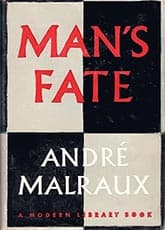 First Modern Library edition, 1934
About the book
Author
André Malraux, France
First publication
1933
Originally titled
La Condition humaine
Also known as
Storm in Shanghai and Man's Estate
Form
Novel
Genre
Literary
Writing language
French
Length
Approx. 108,000 words
Notable lines
Twelve-Thirty Midnight
Should he try to raise the mosquito netting? Or should he strike through it? Chen was torn by anguish: he was sure of himself, yet at the moment he could feel nothing but bewilderment—his eyes riveted to the mass of white gauze that hung from the ceiling over a body less visible than a shadow, and from which emerged only that foot half-turned in sleep, yet living—human flesh.
— First lines
One possesses of another person only what one changes in him, says my father....
One possesses of another person only what one changes in him, says my father....
The embrace by which love holds beings together against solitude did not bring its relief to man; it brought relief only to the madman, to the incomparable monster, dear above all things, that every being is to himself and that he cherishes in his heart.
"Marxism is not a doctrine, it is a will. For the proletariat and those who belong with them—you—it is the will to know themselves, to feel themselves as proletarians, and to conquer as such; you must be Marxists not in order to be right, but in order to conquer without betraying yourselves."
"Europeans never understand anything of China that does not resemble themselves."
"In the business of murder the difficult thing isn't to kill—the thing is not to go to pieces: to be stronger that...what happens inside one at that moment."
The peace of the night once more. Not a siren, nothing but the lapping of the water. Along the banks, near the street lamps crackling with insects, coolies lay sleeping in postures of people afflicted by the plague. Here and there, little round red posters; on them was figured a single character: HUNGER. He felt, as he had a while ago with Ch'en, that on this very night, in all China, and throughout the West, including half of Europe, men were hesitating as he was, torn by the same torment between their discipline and the massacre of their own kind. Those stevedores who were protesting did not understand. But, even when one understood, how choose the sacrifice, here, in this city to which the West looked for the destiny of four hundred million men and perhaps its own, and which was sleeping on the edge of the river in the uneasy sleep of the famished—in impotence, in wretchedness, in hatred?
"But man has no urge to govern: he has an urge to compel, as you said. To be more than a man, in a world of men. To escape man's fate, I was saying. Not powerful: all-powerful. The visionary disease, of which the will to power is only the intellectual justification, is the will to god-head: every man dreams of being god."
"Modern capitalism," he would explain to his students, "is much more a will to organization than to power...."
"Why do you fight?"...He kept his wife, his kid, from dying. That was nothing. Less than nothing. If he had had money, if he could have left it to them, he would have been free to go and get killed. As if the universe had not treated him all his life with kicks in the belly, it now despoiled him of the only dignity he could ever possess—his death.
"I hardly ever weep any more, now," she said with a bitter pride
— Last line
Critique • Quotes
See also:
Buy the book:
X (Twitter):
