Philip Marlowe series
Critique • At the movies
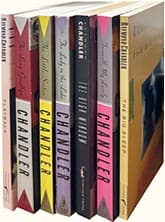 Vintage editions, starting 1976
About the books
Author
Raymond Chandler, United States
First publication
1939–1958
Literary form
Series: seven novels
Genre
Crime, mystery
Writing language
English
• The Big Sleep (1939)
• Farewell, My Lovely (1940)
• The High Window (1942)
• The Lady in the Lake (1943)
• The Little Sister (1949)
• The Long Goodbye (1953)
• Playback (1958)
The tarnishing of the knight errrant
Thanks in part to the movies, Philip Marlowe has become such an icon of the hard-boiled detective story—that genre of the two-fisted, gun-toting, fast quipping, skirt-chasing antihero—we forget what a sensitive softie he is.
Maybe "sensitive softie" is too strong. Or too weak. Marlowe is a tough guy throughout Raymond Chandler's novels.
But he relies on his wits more than fisticuffs. He's more likely to be shot at or beaten up than to deal out the violence himself. Much of the action in the stories is Marlowe reacting to cops, villains and villainesses getting the drop on him—which happens a lot.
He is quick with the sardonic quips, though they come not as throwaway bon mots but mostly in the course of give-and-take dialogues with dubious clients and cagey witnesses. They're self-deprecating as often as offensive. That is, they're part of building scenes and character.
Yes, Marlowe's usually involved with a woman or two or three during each of his cases but not necessarily in a macho way. He's less likely to chase these women (or "girls" as he calls them, though never "dames") than have them fall into his lap—which he brushes off. One of these seductresses is the case's femme fatale and likely to be a killer or, worse, a manipulator of men, driving them to become killers.
Cracks in cynicism
But Marlowe is not quite the same man throughout Chandler's novels. He changes over his career, either as intentional character development or as reflection of the author's changing moods as he worked through the books.
• The Big Sleep (1939) establishes the character's traits—Marlowe's masculinity, his cynicism, his adherence to a code of honour as shown in his view of himself as a knight errant. He recognizes the corruption of the world he works in and does his best to do what's right in it. He rejects the advances of women and sticks to business.
• In Farewell, My Lovely (1940) we see cracks in his cynicism as he takes a case for sentimental reasons. He also displays an understanding of human nature and sense of fairness you might not expect from the hard-bitten gumshoe.
• The High Window (1942) takes these revelations further as he rescues a neurotic secretary from the rich family (his clients) that exploit her and he sends her back to her parents, a philanthropic move that would previously have been out of charcter. This tough but sensitive man can use his skills to save at least one person from a morally bankrupt environment. He is still jaded about the system though and loses interest in seeing the guilty parties in the case are caught or punished. He's still a knight but now described as a "shop-soiled Galahad".
• Moral ambiguity among victim, poloice and murderer are explored in The Lady in the Lake (1943).
• Marlowe hits new lows of lonelilness and cynicism in The Little Sister (1949) and he fails to save few of the people he sets out to protect. The knight is tarnished.
• But the most effective transformation comes in The Long Goodbye (1953). Marlowe is profoundly sad and weary after a lifetime witnessing corruption, seeing justice crushed by wealth and power. After some more personal failures he seems to give up his romantic quests, as symbolized by moving up from his longtime residence in a hotel to a small house.
• In Playback (1958), Marlowe is portrayed as having endured, trusting no one now, having learning nothing positive, just surviving. He's come full circle back to the character he was in The Big Sleep. No longer trying to fix the world, just doing his job. "All business".
Perhaps that was too bleak for even Chandler. At the end of Playback, he has Marlowe reconnect with a woman he'd had a one-night stand with in the previous novel and they share hopes for the future.
In Chandler's unfinished eighth novel, Poodle Springs, he planned to have Marlowe and Loring, rich daughter of a businessman, move to a large house in a California resort town, where Marlowe sets up a detective agency. It all seems a kind of betrayal of the character.
The best and worst
The most famous work in this series is his first novel, The Big Sleep, a notoriously mixed-up story that nonetheless rewards successive readings. If you aren't familiar with the hard-boiled tradition, this is the novel to plunge into to get a sense of the genre's possibilities and difficulties.
Fan favourite Farewell, My Lovely is equally complex but the story benefits from periods when Marlowe stops to review the case, either alone or with a friend. It's also the novel in which we become more aware of Chandler's implied social critique—in the cops' reluctance to investigate the murder of blacks, in the corruption of civic politics, and in the apparent evidence that good people can't get ahead in this world. Moreover, the sharp reader may pick up on the author's mockery of other wordsmiths, especially Hemingway and old-style mystery writers.
The novel most critically praised, however, is the second-last in the series, The Long Goodbye. It shows the writer in late life losing patience with the crime genre and becoming more critical of society and modern life. It's a sprawling novel that only intermittently comes back to the mysteries to be solved—though quite rewardingly.
The intermediate novels—The High Window, The Lady in the Lake, and The Little Sister—also rank among the best detective fiction ever written.
The inevitable falling off doesn come until after The Long Goodbye. Chandler's last completed novel, Playback is a lesser Marlowe tale (and the only one never adapted for film). Poodle Springs, started by Chandler and finished by Robert B. Parker is even worse, which is why it is seldom included as part of the Marlowe series.
And finally, Parker also wrote a sequel to The Big Sleep called Perchance to Dream (1990), about which the less said the better.
A better tribute to Chandler's character is the 1988 collection Raymond Chandler's Philip Marlowe: A Centennial Celebration, which offers twenty-three Marlowe stories by other leading mystery writers, plus a pretty good previously unpublished story by the master himself. Not really part of the series but worth checking out.
— Eric
Critique • At the movies
See also:
The Postman Always Rings Twice
Buy the book:
The Big Sleep; Farewell, My Lovely; The High Window (Everyman's Library)
X (Twitter):
