Sherlock Holmes series
Critique • At the movies
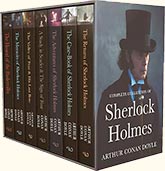 Complete series
About the book
Author
Arthur Conan Doyle, Englnd
First publication
1892
Form
Series: four novels, five story collections
Genre
Crime, mystery
Writing language
English
• A Study in Scarlet, novel (1887)
• The Sign of the Four, novel (1890)
• The Adventures of Sherlock Holmes, story collection (1892)
• The Memoirs of Sherlock Holmes, story collection (1894)
• The Hound of the Baskervilles, novel (1902)
• The Return of Sherlock Holmes, story collection (1905)
• The Valley of Fear, novel (1915)
• His Last Bow, story collection (1917)
• The Case-Book of Sherlock Holmes, story collection (1927)
The intriguing monster
From the moment we meet him in A Study in Scarlet (1887), Sherlock Holmes is a man of startling and off-putting contradictions. He's Einstein-brilliant in areas related to his detective work but ignorant of facts about the world known by school children. A defender of Victorian values of order, yet a slovenly, self-absorbed, thrill-seeking drug addict who loathed society. Insufferably superior but painstakingly sensitive to human nature when it serves him. A driven, passionate man with few if any of the normal emotions. A machine without a heart, as his only close friend Doctor James Watson called him.
Making this nearly inhuman monster the subject of the world's fond and continued interest is the achievement for which Arthur Conan Doyle may not have been sufficiently recognized—not even by himself.
He complained the popularity of Sherlock Holmes was keeping him from receiving his due for his more important literary work.
In his mind the creation of Holmes-styled mysteries was simply a matter of devising ingenious plots to be unravelled by his leading characters who themselves never changed. Unlike literary works that focus on character development, the narratives seldom revealed new nuances or plumbed new depths.
Born storyteller
Doyle would likely be startled to learn that more than a century after his literary birth, his mystery-solving character continues to be of great interest to readers, to imitating writers and to actors who compete to portray him on screen. Sherlock Holmes is widely considered the most popular and influential fictional character of the past two centuries, rivalled only by Count Dracula and Frankenstein's creation. (Note that these are also "monsters" of sorts. Could it be their very inhumanity that intrigues?)
It takes some kind of writer to accomplish this and Doyle's actual writing skill in the Holmes mysteries is not always appreciated. His literary reputation is treated as though he were just lucky to latch onto a catchy character.
Doyle was a born storyteller. The plot points of his Holmes stories utilize certain elements necessary to the genre, which he was instrumental in establishing, but when you read the stories end to end you realize how much he experiments in organizing those points. Invariably he finds new ways to make them work as stories.
Also, if you read them alongside other popular writers' stories of the 1880s and 1890s, you realize how advanced his writing style was for his times. It had its roots in the Victorian habits of over-elaboration and florid vocabulary but is actually closer to the stripped-down, plain-speaking style of twentieth-century writers. Take some of the memorable lines from his works:
To Sherlock Holmes she is always the woman.
"I read nothing except the criminal news and the agony column. The latter is always instructive."
"It is murder, Watson—refined, cold-blooded, deliberate murder."
Such a direct style applied to his foremost character, often in words placed in Watson's voice, means we never sense Doyle is making him up. Holmes's otherwise bizarre contradictions appear as perfectly compatible in this perfectly understood and realized character. Today we may understand Holmes almost as a sociopath—like Patricia Highsmith's masquerading Ripley character or Jeff Lindsay's killer of killers, Dexter Morgan—though operating within the moral bounds of his society.
Adventure of the poor doctor
The device of having the Holmes stories told by Watson—stalwart and cleverer than he makes himself appear—can be credited in part for this success. Doyle's other tales, lacking this narrative filter, range from dull to interesting, but they never enchant the way Holmes and Watson stories do when the game is truly afoot. The peerless detective periodically complains about the doctor sensationalizing his cases, perhaps reflecting Doyle's own misgivings, but without Watson's perspective the stories would be stodgier and far less engaging.
The best known of the cases, The Hound of the Baskervilles (1902), features Watson as the purportedly main investigator for much of the novel. His stumbling efforts to solve the mystery work instead to build up and deepen it. This serves to make Holmes's eventual re-appearance and revelation of his behind-the-scenes discoveries all the more thrilling.
Like Watson, Doyle studied and practised medicine, before poverty led him to try writing and he eventually introduced the famous detective and his chronicler. The character of the gentleman who used minute observation and deduction to reveal hidden truths about people is said to have been based on a doctor, Joseph Bell, with whom Doyle trained as a medical student.
The four novels and fifty-six stories featuring Holmes and Watson have never been out of print, still sell in new volumes that appear almost annually, and have inspired more than five hundred movies and television episodes—with new ones debuting every year.
Claims are made that more Doyle-penned Holmes stories have been discovered and should be added to the canon of fifty-six. But these generally turn out to be stories Doyle discarded at early stages, his self-parodies, short stage treatments, or mysteries that make brief reference to an unnamed detective who may or may not be Holmes. Only one such story seems worthy of being a minor entry to the canon, but its authorship has been debated.
Dozens of other writers have created additional stories and novels featuring Holmes. And dozens more have created sleuthing heroes resembling Holmes in all but name. This is not to mention the entire field of mystery and crime fiction that continues to draw on templates laid down in the Sherlock Holmes stories.
Enduring Holmesian myths
We'll finish with four more facts about the Sherlock Holmes series you may not realize:
- In all Doyle's stories, the good doctor is never told by Holmes that any piece of detection is "Elementary, my dear Watson." The words were, rather, stitched together by writers adapting Holmes to stage and film.
- Despite references to his deductive abilities, Holmes seldom uses the method of logical deduction. As any philosophy student can tell you, at best he uses induction. Or even abduction. Or just inspired guessing. Whatever, his method seems to work and it makes for good stories.
- Doyle never mentions Holmes wearing a "deer-stalker" hat, which would be out of place in London. He does wear an "ear-flapped travelling cap" in his rural excursion in "Silver Blaze" though. The iconic image of Holmes on the hunt for criminals in such attire comes from magazine illustrators.
- The Holmes stories were not the first fictions—or even among the first fictions—to feature a fiercely cerebral detective. Edgar Allan Poe and Wilkie Collins both had characters solve mysteries with reason. Several other Victorian writers also produced stories featuring the solving of crimes before Doyle entered the genre. But Doyle's Sherlock Holmes is the sleuth who has set the standard for generations of fictional detectives to follow.
Hundreds of detectives have come and gone since Doyle's Holmes stories, but readers (and movie and television producers) keep going back to them. The character of Sherlock Holmes continues to repel and attract.
More than that, many people today probably think of Sherlock Holmes as a real historical figure. A figure of legend perhaps but with a basis in facts—like Robin Hood or King Arthur.
An incredible literary achievement for a poor Victorian doctor who wanted to change the world with words, for which he should be given, and should accept, credit.
— Eric
Critique • Quotes • Text • At the movies
