Adventures of Huckleberry Finn
Critique • Quotes • Text • At the movies
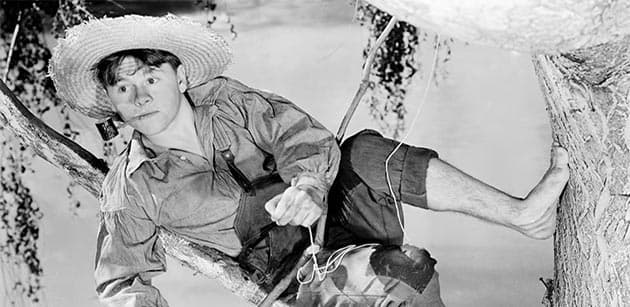
Mickey Rooney stars as the title character in Hollywood's 1939 Huckleberry Finn adaptation.
The illusory comeback
The Adventures of Huckleberry Finn (1990): Film, 92 minutes; director Richard Thorpe; writer Hugo Butler, Waldo Salt (uncredited); featuring Mickey Rooney, Rex Ingram, Walter Connolly, William Frawley, Elisabeth Risdon, Clara Blandick, Victor Kilian, Minor Watson
It was probable inevitable the actor famed for portraying the all-American boy would appear in a film of the book hailed as the "great American novel"—featuring the exploits of a young boy, to boot.
Andy Rooney was just hitting the peak of his success, having already made more than four dozen films and becoming one of Hollywood's top stars for several years to come. But The Adventures of Huckleberry Finn turned out not be one of his classic films. It's little referenced today, though it was highly successful at the box office in 1939.
Some critics have charged the problem was miscasting: at eighteen, Rooney was said to be too old to play the Huck. But this is not apparent in the film. The short and sweet-faced Rooney could have passed for fourteen, which would be appropriate for the story. And his acting is winsome, as usual, drawing viewers into sympathy for his character facing the perplexities of growing up.
The film is more aptly criticized for taking the edges off Mark Twain's often dark and satirical writing, especially his critiques of Christian and slave-owning society. This hits closer to home. Despite scenes of vigilantism, hints of racial hatred, and Jim's incarceration, The Adventures of Huckleberry Finn is a remarkably cheery film in which a happy conclusion is never in doubt.
The accomplished actor Rex Ingram is little challenged by the role of the good-natured, runaway slave, Jim, who turns himself in to save Huck after the boy is bitten by a rattlesnake and who in turn is saved by Huck from a mob-besieged jail. As the script is written, Jim is never bitter, angry or otherwise rebellious—as he has the right to be—but always servile, noble or scared silly in stereotypical fashion.
Trailer highlighting Mickey Rooney in The Adventures of Huckleberry Finn.
The biggest problem with the story as presented here, though, may be just that it's too condensed. In its hour and a half, it collapses myriad adventures into two or three main plot lines. Missing altogether are several Twain-written adventures, including the sinking of the riverboat and the thirty-year feud that Huck gets caught up in.
The escapades of the two con men that Huck and Jim run into on the Mississippi is kept and played for all its entertaining and tragicomic effects, although these subplots too are slimmed down.
Worse though is the skimping on life on the river. We see our characters rafting the water, escaping downriver, and at one point even praying to the river (that's Huck as he's river-boating against the current to save Jim). But with all the frantic action we don't have time to really sit back with our guys and drift downstream, lazily contemplating the peace and freedom the mighty river brings to their souls—as close as Twain gets to spirituality in the novel.
The removal of one major part of the book's plot though is actually an improvement. The arrival of Tom Sawyer in the last quarter of the novel with his fanciful plans to free Jim from captivity is the weakest part of Twain's story and the film is better without it.
One addition to the story is also noteworthy. In the novel, Jim is freed in Miss Watson's will. In the film, Huck successfully pleads for Jim's freedom as his adventures have turned him into an abolitionist. His speech against anyone owning another person may seem pallid and unoriginal now but it probably came across as enlightening at the time.
And this may be the legacy of the film. Much as it knocks many of the sharp corners off Twain's critique and some of the rough, colloquial language off his prose, this version of the Adventures of Huckleberry Finn is pleasing enough to show audiences the essence—or some of the essence—of America's greatest novel.
— Eric
See also:
Buy the book:
X (Twitter):
