Middlemarch
Critique • Quotes • Text • At the movies
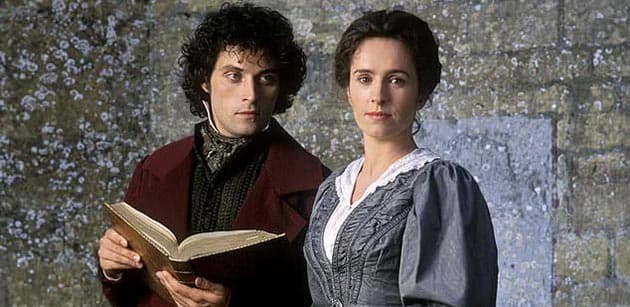
Will (Rufus Sewell) and Dorothea (Juliet Aubrey) flaut tradition in the Middlemarch miniseries.
Romance in the real world
Middlemarch (1994): Television miniseries, approx. six hours; director Anthony Page; writer Andrew Davies; featuring Juliet Aubrey, Rufus Sewell, Douglas Hodge, Patrick Malahide, Trevyn McDowell, Robert Hardy, Jonathan Firth, Michael Hordern
Despite being considered one of the greatest novels —if not the greatest novel—of English literature, Middlemarch has had only two serious screen adaptations. Only one survives and is publicly available.
But it's all we need.
The 1994 miniseries is as comprehensive and faithful presentation of author George Eliot's work as we've seen. Perhaps as comprehensive and faithful adaptation of any modern classic writer's work as ever seen.
In their efforts to condensed sprawling plots, adaptations are commonly criticized for missing emotional nuances. But no screenplay can cover a novel's every detail. The question is not whether some nuances are skipped—thery always are—but rather which nuances are skipped and which kept. The intent should be to include all the beats necessary to bring the story to life as the author had presented it.
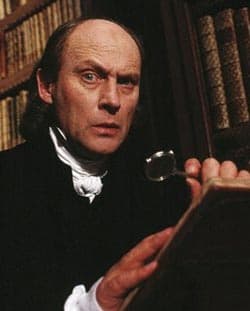
Patrick Malahide as Rev. Casaubon
The six-hour Middlemarch series succeeds at this amazingly well. Welsh writer Andrew Davies who would go on to do screenplays for more than twenty classic novels—including Pride and Prejudice (1995), Bleak House (2005), and Sense and Sensibility (2008)—presents his first masterpiece here.
After living through the full production, you have to think hard to recall what's been left out. You may note a few secondary or tertiary characters whose stories have been trimmed or a few of Eliot's scenes that have been shortened or compressed together, but nothing is missing that you actually...miss.
Yet the series proceeds at a leisurely pace—one of the few criticisms being that it's too slow. But that's illusory. Like the novel, this Middlemarch isn't sluggish but it lets the action and behaviours of the characters arise naturally from their social and natural environs, instead of forcing them into the spotlight. A lot is going on under the placid surface. In critical terms, that's called depth.
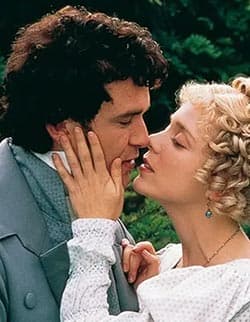
Lydgate (Douglas Hodge) and Rosamund (Trevyn McDowell)
Actors seem not to be acting at all, but feeling, stumbling, their ways through a changing world during uncertain times, finding footholds where they can in Eliot's panoramic exploration of village and countryside life.
Especially effective are the romantic leads, starting with Juliet Aubry who shines—almost literally—as the purpose-driven Dorothea Brooke, pursued by Rufus Sewell in his breakthrough role as the passionate, Byronic-style artist Will Ladislaw but trapped in a loveless marriage with an older man.
This latter figure is the story's most disturbing character. Painfully portrayed by British stage and screen actor Patrick Malahide, the emotionally arid Rev. Edward Casaubon appears devoted to finishing his great scholarly project on the "Key to all Mythologies". Dorothea is drawn into helping him accomplish his great work—before she realizes it is an outdated work of pedantry never to be completed.
Porducing almost as much drama is the coupling of Dr. Tertius Lydgate and Rosamund Vincy—but with far different resolutions. Douglas Hodge is perfect as the idealistic new doctor in town with big plans for a local hospital, and Trevyn McDowell is a natural as the beautiful but maddeningly self-centred woman who marries and ruins him.
Remarkably, the novel's third biggest romantic pairing—between childhood sweethearts Fred Vincy and Mary Garth—is also played out in sufficient (but less) detail by Jonathan Firth (yes, Colin Firth's brother) and Rachel Power.
A plea for remembering 1994's Middlemarch miniseries.
In case this gives you the idea Middlemarch is a romance, note these relationships take place amid politicial upheaval, business scheming and village strife—all realistically woven together in the film's unsentimental style.
Many of Britain's great actors fill the myriad minor but colourful parts—including the great Michael Hordern in his last role as the wealthy landlord Peter Featherstone and the always engaging Robert Hardy as Dorothea's uncle and would-be reformer Arthur Brooke. Judi Dench performs in a voiceover.
The only problem Eliot fans might have with this production is the ending. It's happier, more optimistic, than that of the novel's epilogue-like "finale" that shows most of the main characters living lives of compromise and quiet contentment at best.
But that's okay. After six hours of fidelity to Eliot's greatest work of social realism, Middlemarch may be allowed a slight departure into romanticism in its dying scenes.
— Eric
See also:
Buy the book:
X (Twitter):
