Margaret Atwood
Critique • Works • Views and quotes
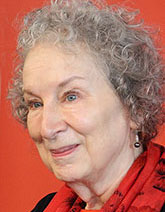 Atwood in 2017 (ActuaLitté)
About the author
Born
Ottawa, Canada, 1939
Places lived
Ottawa; Sault Ste. Marie; Toronto, Canada
Nationality
Canadian
Publications
Novels, stories, poetry, plays, criticism
Genres
Literary, science fiction, dystopian, satire
Writing language
English
Literature
• The Handmaid's Tale (1985)
• The Blind Assassin (2000)
Novels
• The Handmaid's Tale (1985)
• The Blind Assassin (2000)
Poems
• "In the Secular Night" (1995)
Poetry Collections
• Power Politics (1971)
Canadian Literature
• Power Politics (1971)
• Surfacing (1972)
• The Handmaid's Tale (1985)
• Cat's Eye (1988)
• The Robber Bride (1993)
• The Blind Assassin (2000)
• Oryx and Crake (1971)
Historical Fiction
• Alias Grace (1996)
• The Blind Assassin (2000)
Literary Fiction
• The Handmaid's Tale (1985)
• The Blind Assassin (2000)
Science Fiction
• The Handmaid's Tale (1985)
• Oryx and Crake (1971)
Utopias and Dystopias
• The Handmaid's Tale (1985)
• The MaddAddam Trilogy (2003–2013)
Hook, line and sinker
Before she became an internationally famous novelist, Margaret Atwood wrote a few lines that have stayed with me ever since:
you fit into me
like a hook into an eye
a fish hook
an open eye
This poem from Power Politics (1971) has stayed with me because it is so terrible—that is, presenting a terrifying image. But I also have a lingering resentment over being suckered in these lines. The setup and punchline are too obviously manufactured, and yet one can imagine many readers first recoiling and then gleefully accepting the hit against the nameless "you" of the poem.
Another reason these lines have plagued me is because I keep finding them in Atwood's writing in one form or another. For instance, her narrators are always examining apparently innocent words to find hidden malice. From her most popular novel, The Handmaid's Tale (1985):
I sit in the chair and think about the word chair. It can also mean the leader of a meeting. It can also mean a mode of execution.
From her Booker Prize-winning The Blind Assassin (1985):
To the task at hand. At hand is appropriate: sometimes it seems to me that it's only my hand writing, not the rest of me; that my hand has taken on a life of its own, and will keep on going, even if severed from the rest of me, like some embalmed Egyptian fetish or the dried rabbit claws men used to suspend from their car mirrors for luck....
It's not just the flipping over of expressions to find bugs underneath that annoys. That by itself might not even be annoying, and you could argue it's part of a writer's job to examine our everyday sunny language to find the darker subtext.
But this quirk is symptomatic of Atwood's plots, characters and themes. A continual setup and punch down. The smile of nearly every personality, apart from the heroine, is quickly shown to mask hurtful motives. Everyone it seems is a shit, bent to some victimizing scheme.
But it can't be just the negativity that is tiresome. Many authors, including many classic writers, feature self-serving characters, who are nonetheless intriguing to read about.
Nor do the sexual politics—Atwood being somewhat of a feminist icon—offend, as I probably share most of Atwood's social views, as far as I know them. (And agreeing with an author should not be a prerequisite to appreciating his or her work.)
Perhaps it is the continual irony, the dominant mode of humour of this age, that wearies. Or maybe it's resentment at being consciously tricked over and over again. Though the trick is so expected now, it no longer surprises. One reads Atwood in a protracted state of expecting next shoes to drop.
Some readers tell me they have the same reaction. However, Atwood deservedly has many more fiercely loyal fans than detractors, judging by her wide success and the international critical acclaim that greets each new work, as well as by the raves on reading websites.
Edgy beginnings
Atwood was born in Ottawa and spent her first years in northern Ontario and Quebec before moving to Toronto as a child. She studied at the University of Toronto where she was influenced by renowned literary analyst Northrop Frye, and then at Cambridge and Harvard. While a student, she published poetry in various magazines as well as in two collections, Double Persephone (1961) and The Circle Game (1964, revised 1966) which won Canada's Governor General's Award.
Her first novel, The Edible Woman (1969), was an edgy but deliciously humorous story of a woman who works in market research and comes to see herself as a consumer product. Its satire is more accessible and enjoyable than in her later, better-known novels.
Her second novel, Surfacing (1972), takes place in northern Quebec where a young woman arrives with several friends to investigate the disappearance of her father. Compared to The Edible Woman, this short novel is humourless and contrived, with stereotypical characters. Hailed by some critics and hated by others, it seems more like a novelization of the controversial literary study she also published that year. Survival: A Thematic Guide to Canadian Literature interpreted Canadian writing as exhibiting a colonial mentality, an exercise in victimhood, caught between the powerful United States to the south and the vast frozen north.
She continued producing volumes of poetry throughout this period with The Animals in That Country (1968), The Journals of Susanna Moodie (1970), Procedures for Underground (1970), You Are Happy (1974), and her most effective collection, Power Politics (1971). Her first Selected Poems appeared in 1976.Lady Oracle (1976) returns to the pointed lightness of her first novel, with a magical tale of a bored activist's wife who takes off on her own literary and political adventures. Atwood's next, Life Before Man (1979), however is a dreary story of people trapped in dreary relationships, supposedly saying something about male-female power relationships, as all her works do, but already seeming dated.
Her best-known work so far came several books later in 1985 with The Handmaid's Tale. This novel depicts a society in which women have lost all rights and freedoms, except to be wives, housekeepers and child-bearers. It was adapted for film in 1990 with a screenplay by Harold Pinter and more recently for a popular television series.
Cat's Eye (1988) is another depressing story of a woman in a midlife crisis, this time an artist persecuted by her lifelong best friend. The Robber Bride (1994) is about three women in midlife crises, persecuted by an old friend they had thought was dead.
Atwood's next three novels are the works that have made her a best-selling international literary figure. Alias Grace (1996) is based on a true story of a maid imprisoned in 1843 for the murder of her employer. The Blind Assassin (2000), one of her most complicated—some would say difficult—novels, won the world's top prize for English literature. It is a family saga, told as a story within a story within a story, involving politics, scandal and a bit of a mystery.
Oryx and Crake (2003) takes place in a post-apocalyptic wasteland. As with Handmaid's Tale, this is really in the line of science fiction novels, although not presented with the commercially deadly SF tag. Unlike Handmaid's Tale, however, it never rises above being run-of-the-mill speculative fiction, with no more content or ideas than has already been presented in any number of science-fiction short stories or novellas, but padded out here to numbing novel length. Second-rate SF. Startling only to those who have never been exposed to these timeworn concepts of speculative fiction before.
However, the apocalyptic world of Oryx and Crake has been fleshed out with two sequels The Year of the Flood (2009) and MaddAddam (2013) that altogether comprise a satisfyingly complete trilogy, presenting hope of recovery from our self-destruction.
And a sequel to A Handmaid's Tale, named The Testaments (2019), has also been published to greater acclaim, winning the Booker Prize and other awards.
Dark anthologies
Throughout her novel-writing run, Atwood has continued to publish dozens of short stories, poetry collections, essays and critical works at an impressive clip. Her short stories have often been experimental, filling books with both traditionally presented stories and brief pieces that may be called vignettes, sketches, fables or even just observations.
Moral Disorder (2006), is a series of short stories linked by recurring characters, which together might qualify as a novel. Trouble is, the characters are not particularly interesting and their stories are not particularly appealing either. As befitting the title, nothing really stands out around which the overall work might be organized, although certain passages—especially those regarding memories of childhood—do show glimpses of the spooky power of which the former poet is capable.
Some of Atwood's more offbeat shorter pieces and collections I find more enjoyable than her heavy-duty literary works. Murder in the Dark (1993) and Good Bones (1992) are anthologies of creative exercises—stories, prose poems, vignettes, sketches. They come across as playing around with concepts and word associations in search of the bases of longer stories or speculative novels, but even so they are delightful—even with Atwood's darkly ironic humour at its sharpest—as short pieces standing on their own.
More recently one of her odder works, The Penelopiad, has become a favourite of mine—perhaps because it's shorter than her novels or because her jaundiced satire is more palatably turned on the classics. It's the Odyssey, as told by the pitiable figures of Ulysses's waiting wife and her ill-fated maids. A great idea I can't believe hadn't been thought of before.
Atwood's nonfiction and her short fiction also have their avid followings. But her long-term reputation will likely rise or fall on the novels—the centre circle under the literary tent. And the hard-working Atwood no doubt has several acts left to present to alternately engage and annoy readers like me.
— Eric
Critique • Works • Views and quotes

.jpg)