Orson Scott Card
Critique
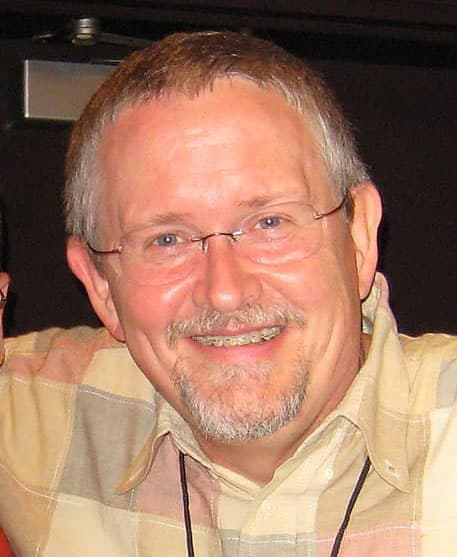
.jpg)
Born
Richland, Washington, United States, 1951
Nationality
American
Publications
Novels, novellas, plays, stories, essays
Genres
Science fiction
Writing language
English
Literature
• Ender's Game (1985–1986)
Novels
• Ender's Game (1985–1986)
American Literature
• Ender's Game (1985)
• Speaker for the Dead (1985–1986)
Science Fiction
• Ender's Game (1985)
• Speaker for the Dead (1985–1986)
Lots to like, in the end
What I don't like about Orson Scott Card:
• He's very religious—a devoted Mormon whose works have sometimes been based on his religious views and the history of the Church of the Latter Days Saints.
• He's very conservative, judging by the underlying themes in his works and by his political commentaries on the internet (right wing by non-American standards anyway—I'm not sure how he's perceived in the U.S.).
On the other hand...
What I do like about Orson Scott Card:
• His treatment of religion in his mainstream science fiction is intelligent and interesting.
• He's a prolific, versatile writer who has handled a wide-range of styles and topics. In some ways a writer's writer, though also definitely a reader's writer—writing to communicate with a reader, not to impress or intimidate.
• His books have plots!
• He has a lot of practical knowledge about writing and is willing to share it widely—for free—on the Internet. Would-be writers, take notes.
• He wrote Speaker for the Dead, one of the best science fiction novels I've read.
Facts about Orson Scott Card:
• Born in Richland, Washington, raised in California, Arizona and Utah where he got degrees from Brigham Young University and the University of Utah. Spent two years as a Mormon missionary in Brazil.
• Wrote religious plays and fiction for awhile but won his first major acclaim in 1977 for a short story "Ender's Game" which was nominated for a Hugo award.
• After this, wrote many more sci-fi stories and novels, among them The Worthing Chronicle (1979) and Hart's Hope (1983), to lukewarm response, However, his extensive revision of The Worthing Chronicle in 1983 is highly regarded.
• Expanded the Ender story into two novels, Ender's Game (1985) and Speaker for the Dead (1986), both of which won both the Hugo and the Nebula awards, science fiction's two highest honours—the first time an author won both in successive years. The novels look at human confrontations with two alien species three thousand years apart, the first novel being mainly an action-oriented war story and the latter a psychological, character-driven story.
• Demand for more instalments, in what came to known as the Ender saga, led to the novels Xenocide (1991), Children of the Mind (1996), Ender's Shadow (1999), Shadow of the Hegemon (2000) and Shadow Puppets (2002), as well as the story collection First Meetings: In the Enderverse (2002).
• Another novel sequence, starting with Seventh Son in 1987, depicts an alternative history of the United States with the life of Alvin Maker being a parallel to that of Joseph Smith, the real-life founder of the Mormon Church. Every couple of years a new volume in the Alvin Maker series seems to be published.
• Other notable works: Wyrms (1987) about a woman on an alien world she is meant to save, The Abyss (1989) novelization of the James Cameron movie about aliens discovered in the deep sea, the five-part Homecoming novel series starting with The Memory of Earth (1992), and Lost Boys (1992), a popular ghost story not to be confused with a similarly named vampire flick.
And that's only about half of what he's written. So far. Told you he's prolific.
— Eric
Critique
See also:
Buy the book:
The Ender Saga: Ender's Game, Speaker for the Dead, Xenocide, Children of the Mind, Ender in Exile
X (Twitter):
