G.K. Chesterton
Critique • Works • Views & quotes
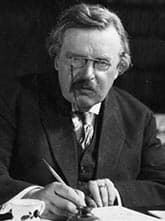 Chesterton, undated
About the author
Born
London, England, 1874
Died
Beaconsfield, England, 1936
Places lived
London; Beaconsfield, England
Nationality
English
Publications
Novels, stories, essays, poetry, plays, criticism, biography
Genres
Literary, mystery, fantasy, satire
Writing language
English
Literature
• The Innocence of Father Brown (1911)
Novels
• The Man Who Was Thursday (1908)
Stories
• "The Blue Cross" (1910)
Story Collections
• The Innocence of Father Brown (1911)
British Literature
• The Man Who Was Thursday (1908)
• The Innocence of Father Brown (1911)
Crime and Mystery
• The Man Who Was Thursday (1908)
• The Innocence of Father Brown (1911)
Crime and Mystery Series
• Father Brown series (1911–1935)
Genius recalled
His friend and opponent George Bernard Shaw called him a "colossal genius".
If we no longer consider G.K. Chesterton a colossal genius, it is not because we consider him any less brilliant now but because we do not consider him at all.
If Chesterton were the colossal proponent of progressive liberal ideas, he would likely be enshrined in the pantheon of early twentieth-century luminaries alongside his contemporaries Shaw and H.G. Wells. But the orthodox Christianity he championed, the Roman Catholic version in his latter life, no longer seems the kind of cause we consider worthy of modern geniuses.
His books and essays on religion, social issues, economics, literary criticism and humour can still be appreciated today as brilliantly witty, insightful and sensible polemics, even by those of us who, like Shaw in his day, disagree with him strongly. You can find most of these works on Internet sites devoted to Chesterton.
But for most readers today he is remembered for a series of mystery stories he wrote to support the work he considered more important.
Gilbert Keith Chesterton was born into a middle-class family in London. He dropped out of university to work as a journalist. For the rest of his life most of his work appeared first in periodicals, including his own publication, G.K.'s Weekly.
He was also a poet, his first book being a collection, Greybeards at Play (1900). This was followed by his first two of many literary biographies, Robert Browning (1903) and Charles Dickens (1906),
His first novel ,The Napoleon of Notting Hill (1904), is a political satire which many readers consider his most entertaining work. It's set in England in 1984. (The coincidence of that date with George Orwell's later dystopian novel has been noted.)
The Man Who Was Thursday (1908) is widely considered Chesterton's best fictional work. The novel is presented as a detective story but its surrealistic twists and unworldly characters turn it into a Christian allegory—a kind of "metaphysical thriller", as it's been called.
Legacy of the priest
Chesterton's first short story featuring the crime-solving priest, Father Brown, was "The Blue Cross", appearing in a magazine in 1910. With eleven other stories, it was reprinted in The Innocence of Father Brown (1911), which became a sensation. It was heralded as the greatest development of the mystery since Conan Doyle's Sherlock Holmes stories
Four other collections of Father Brown mysteries were published during Chesterton's life: The Wisdom of Father Brown (1914), The Incredulity of Father Brown (1926), The Secret of Father Brown (1927) and The Scandal of Father Brown (1935).
The stories have been plundered for both faithful and loose adaptations on stage, film and television dozens of times around the world. And the Father Brown character has been the model for many another religious sleuth in works of entertainment over the century since the priest's appearance.
Chesterton produced over a hundred books during his lifetime, and many more anthologies of his works have been published since his death in 1936.
Unfortunately in recent decades his works and ideas have disappeared from public discourse, leaving only an impression of stuffy reaction in the collective memory. Which is our loss, as his writings—like those of the yet popular C.S. Lewis and J.R.R. Tolkien—ventured beyond their religiously conservative underpinnings to offer insights into life in this world to provoke readers of even little or no faith.
If it's only his mysteries and mysterious satire that survive widely to draw the occasional reader back into his heavier thoughts, then that's all to the good.
And for those of us for whom the popular works are enough—well, that alone is a greater legacy than Chesterton himself probably gave himself credit for.
— Eric
Critique • Works • Views & quotes
