Dashiell Hammett
Critique • Works
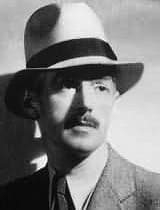
Born
St. Mary's County, Maryland, 1894
Died
New York City, United States, 2001
Places lived
Philadelphia, United States; Baltimore; Tacoma, Washington; San Francisco, California; New York City; West Virginia; Pleasantville, New York;
Nationality
American
Forms of writing
Novels, stories, screenplays, essays
Genres
Crime, mystery, detective fiction
Writing language
English
Literature
• The Maltese Falcon (1930)
• The Thin Man (1934)
Novels
• Red Harvest (1929)
• The Maltese Falcon (1930)
• The Thin Man (1934)
Stories
• "The Gutting of Couffignal" (1925)
American Literature
• The Maltese Falcon (1930)
• The Glass Key (1931)
• The Thin Man (1934)
Crime and Mystery
• Red Harvest (1929)
• The Maltese Falcon (1930)
• The Glass Key (1931)
• The Thin Man (1934)
• The Continental Op (1945)
Crime and Mystery Series
• The Continental Op (1923–1930)
Crime and Mystery Stories
• "The Gutting of Couffignal" (1925)
Thrillers
• The Maltese Falcon (1930)
Birth of the unholy trinity
Dashiell Hammett may be better known today as a character himself than as a creator of fictional private detectives. He keeps popping up in books and movies as a boozing private eye in his own right, or as the mentor and lover of playwright Lillian Hellman, or as a communist sympathizer who defied the McCarthyists in the 1950s.
As a writer he gave us the Continental Op, Sam Spade and Nick Charles, who themselves may be better known as characters in movies than for their existence in seminal crime novels. (Spade was played most famously by Humphrey Bogart, Charles by William Powell, and the Op by James Cobourn for a television miniseries.)
But among crime and mystery readers, Hammett is credited with founding the hardboiled school of detective writing.
Some admirers would go further and claim Dashiell Hammett's influence on modern American literature is comparable to that of such mainstream literary lights as Ernest Hemingway, John O'Hara, or John Steinbeck. They all emerged as writers in the 1920s and 1930s and had similar impacts on American writing. Writers for the rest of the century emulated their clear, colloquial, evocative but understated prose—in both high literature and and genre work.
Yet Hammett produced only a handful of crime and mystery novels in his lifetime. Nothing past the age of forty.
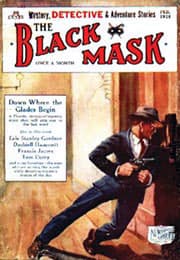
1926 issue of Black Mask
with Hammett story
"The Assistant Murderer"
He was born in Maryland, USA, and grew up in Philadelphia and Baltimore. From his mid-teens he held a variety of menial jobs until he became an operative for the famous Pinkerton's Detective Agency, which would give him material for his later short stories narrated by the nameless "Continental Op". He was a sergeant in both World Wars I and II. But it was between the wars that he became known as the master of American detective fiction.
After the First World War, he took to writing for magazines, notably the pulp detective periodical Black Mask. He developed a style of writing in which the literary frills are completely eliminated to focus on the dialogue and action. Yet this did not prevent his stories from having realistic characterizations or heart. Rather these were to be inferred from the terse speech and the behaviour of his characters.
In a passage that's often used as a book-cover blurb, the New York Times said:
Hammett's prose was clean and entirely unique. His characters were as sharply and economically defined as any in American fiction. His gift of invention never tempted him beyond the limits of credibility.
The Continental Op stories and other examples of his pulp fiction featured cynical heroes. Men who knew the score and worked within a corrupt system, as long as it did not compromise their personal principles of loyalty to friends and protection of the innocent. These stories are collected in several volumes, including The Continental Op (1930 and 1974), The Big Knockover (1966) and Nightmare Town (1996).
The big emotional payoff
His novels are more rewarding though and show an interesting development from the stories. The first two, Red Harvest and The Dain Curse (both 1929) are like longer versions of his stories, with more developed plots but still told in first person in the just-the-facts style.
His third novel, The Maltese Falcon, (1930) is his acknowledged classic in which private eye Sam Spade solves a complicated mystery while proving his loyalty to a flawed comrade. The story now is told in the third person with greater subtlety and a bigger emotional payoff. The basis for three Hollywood treatments.
The Glass Key (1931) follows with one of the most telegraphically written stories you'll ever read. It's a personal favourite of mine for how much it leaves unsaid and for its cynical peek into the kind of corrupt politics that once ruled American cities. (Different from the kind of corruption that rules today.) It's also a good mystery, although that aspect seems less important by the time you get to the solution. The hardest of the hardboiled. Made into at least two films, including a passable version starring Alan Ladd and Veronica Lake in 1942.
A year after The Glass Key, The Thin Man (1932) is an altogether different revelation. A story of a high-living couple who solve crimes between drinks and quips and who are—unheard of in the crime-busting genre and unexpected from the master of tough-guy fiction—sincerely affectionate with each other. Adapted for a delightful movie and multiple entertaining sequels.
And that's all he wrote, at least for books—apart from Woman in the Dark, A Novel of Dangerous Romance (1933), which was a hardboiled novella originally printed in three magazine instalments, and some unfinished pieces that occasionally surface. For almost three decades until his death in 1961 he published nothing of import. Maybe it was his recurring illness from the war, maybe it was his alcoholism, maybe it was his leftist politics, or maybe it was his turbulent romance with Hellman. (Her career took off in 1934 with her first successful play just as his career was ending and it has been suggested his editing of her work actually amounted to co-writing.) Or perhaps it was classic writer's block. But Hammett was heard from no more as a serious writer.
In the 1930s and 1940s he wrote for the movies (two new storylines for sequels to The Thin Man film) and radio (some scripts for a popular Thin Man series, as well as for a show called Brad Runyon, The Fat Man, about a hefty detective based on his Continental Op).
Still, Dashiell Hammett stands with his two most prominent successors, Raymond Chandler and Ross Macdonald, as part of the unholy trinity of great, distinctively American crime writers. Chandler and Macdonald expanded on the private eye's code, added more sardonic humour and softened some corners. Macdonald more psychological insight. And countless others have copied or parodied Hammett's style. But the original can't be beat.
— Eric
Critique • Works
