
Ross Macdonald
Critique • Works
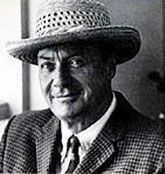
Born
1915
Died
1983
Publications
Novels
Writing languages
English
Novel Series
• Lew Archer (1949–1976)
American Literature
• The Galton Case (1959)
Crime and Mystery
• The Galton Case (1959)
• The Blue Hammer (1976)
Crime and Mystery Series
• Lew Archer series (1949–1976)
The Macdonald case
The third figure in the holy trinity of American crime writing, after Dashiell Hammett and Raymond Chandler, Ross Macdonald was actually Canadian in his upbringing. Which may be credited (or blamed) for his more nuanced development of the hard-boiled style.
Not that he's any softie. If anything, Macdonald is tougher as a writer because he unflinchingly goes into the deeper causes of his characters' predicaments.
In other classic detective tales an emotional relationship is revealed at the heart of a case: a tough guy's in love with a scheming dame, a rich daddy protects the offspring he knows is no good, a sleuth holds loyalty to his friend higher than personal gain. And you accept it, maybe even admire it, as part of the code. But you don't necessarily believe that's the way the world works.
Well, when Macdonald's Lew Archer kicks over the rocks, you really believe what he finds there.
For thrillers, Macdonald's novels generally start off rather low-keyed, even laid-back, and their usual protagonist, Lew Archer, works the cases without heroics. He's no superhero throwing his weight or firepower around. In fact, he usually ends up on the wrong end of any fisticuffs. He's a fairly ordinary man, almost a non-entity, who patiently accumulates information, figuring his subjects out, until he's deep into a dark mystery at the heart of a family or community.
Drawing subliminal pictures
If Macdonald's books are less adaptable to movies than, say, Chandler's, it may be because he doesn't share his forerunner's focus on creating great dramatic scenes. Rather, his characters' interactions slowly and realistically add to the novels' overall impact, building to the climax.
Similarly, he eschews those wonderfully colourful and provocative cracks beloved by Chandler readers. ("It was a blonde. A blonde to make a bishop kick a hole in a stained-glass window.")
Macdonald did have a deft hand at expressive lines. But rather than draw attention to themselves, they quickly drew pictures for the readers, almost subliminally. Here are a few examples from the first few pages of A Zebra-Striped Hearse, a mid-career work that happens to be sitting on my desk:
She had the kind of style that didn't go with her make-up....
She wasn't using her charm on me, exactly. The charm was merely there.
It was a face that had known suffering, and seemed to be renewing the acquaintance.
They walked very formally together, like people on their way to a funeral.
Those are the kinds of observations that many a literary writer would spend a paragraph on to get the same ideas across, that Macdonald seemingly just throws off casually.
And that's why, although he is arguably not quite as flashy in his construction, Macdonald is up there with the great writers of the twentieth century. He provides the third step in raising American crime fiction to respectable standards. His Archer novels develop what Hammett and (particularly late) Chandler hinted at: the mystery's capacity for social critique and psychological insight.
But let's not get all professorial here. As a reader you don't ever really notice this feat being accomplished. It just slips in along with the good read. With the believable dialogue and credible plots. Macdonald is still best regarded as having written some of the most exciting and engrossing detective novels. Page-turners, nearly all of them.
Many of the mysteries have to do with identity issues, exposing the secret lives of his sleuth's middle-class clients, especially sorting out their troubled children—a preoccupation that is often attributed to the author's own mixed-up upbringing, and to his own tragic experiences as a parent.
Blame Canada
He was born Kenneth Millar in California but from the age of four he was raised in Vancouver, British Columbia, briefly, and then in Kitchener, Ontario. Despite a youth of poverty, mistreatment, and petty crime he made it to the University of Western Ontario, thanks to a small legacy and looked to writing as a career. In 1938 he married a former high school mate, Margaret Sturm, a Canadian who also wanted to write. Thus began a lifelong relationship of collaboration, competition and battles, both private and public.
To make a living he took teacher training at the University of Toronto and then a job at his old Kitchener high school. His wife Margaret was first to write and publish mystery novels, which he helped plot and edit. With the proceeds, they moved to Ann Arbor, Michigan. Ken taught at the University of Michigan, then studied with poet W. H. Auden, and began a doctoral dissertation on Samuel Coleridge. He also published his own thriller, The Dark Tunnel (1944). But the Second World War took him into the U.S. Navy and the Millars to Southern California.
His next publishing effort, Trouble Follows Me (1946), emulated the hard-boiled style popularized in film noir of the day, though perhaps not entirely successfully, as it retained some literary and descriptive flourishes along with its sardonic observations and sharp dialogue. An interesting innovation however is having the murders—and sleuthing—take place in different American locations from Honolulu to Detroit, as well as on a transcontinental train, giving the work the feel of a thriller more than a crime novel.
Meanwhile, Margaret Millar's continuingly more successful publishing got them a house in Santa Barbara (which was to become Santa Teresa in his novels) and got her work in the Hollywood studios.
Ken Millar came up with his sleuth, Archer, in his fifth novel, The Moving Target (1949), which borrowed from Hammett and Chandler. It was followed by The Drowning Pool (1950), which developed the character and narrative style further. For these books he adopted the nom de plume of "John Macdonald" and then (to differentiate himself from crime writer John D. MacDonald) "John Ross Macdonald". They're terrific mysteries in the Hammett-Chandler tradition but introducing a new more easy-going detective avatar for the postwar era and they proved quite successful. They were later adapted into movies starring Paul Newman (though the sleuth's surname was changed to Harper in the films).
Another fifteen Archer novels were to follow, but the Millar family drama also continued. The Millars' troublesome sixteen-year-old daughter caused a fatality while driving their car and her parents tried to shield her from criminal proceedings, causing a scandal in Santa Barbara. Many blamed the parents' sordid writing subjects for the daughters' problems.
Ken himself, who is thought to have tried to commit suicide at least once, underwent Freudian psychoanalysis. "My half-suppressed Canadian years, my whole childhood and youth, rose like a corpse from the bottom of the sea to confront me," he is quoted as saying.
Some of the psychological revelations—and even personal details—found their way into his writing. The most significant of these works is The Galton Case (1959), in which Archer traces an elusive character back to a sordid past in "Kingsville", Ontario. The novel also stands as a landmark for its use of psychological insight in crime fiction, although it was not immediately recognized as such.
It was only in the 1960s with television and movies taking an interest in his books that "Ross Macdonald", as he was now called, began to receive his due acclaim as more than a genre writer. His personal and family dramas continued, but he turned out novels to good reviews and sales. Among them are the classic mysteries The Goodbye Look (1969) and The Underground Man (1971). The latter uses details from Millar's real-life fight to save his home from a forest fire and, reflecting a growing concern of his, bears a strong ecological message. It was made into a TV movie in 1974, starring Peter Graves as Archer. Both Millars were active in the protests against the 1969 Santa Barbara oil spill, which features in Sleeping Beauty (1973).
After his twenty-fourth novel, The Blue Hammer (1976), as he seemed to be moving into another new direction for crime writing, Millar suffered memory problems, which were eventually diagnosed as Alzheimer's and led to his death in 1983.
— Eric
Critique • Works
