William Trevor
Critique
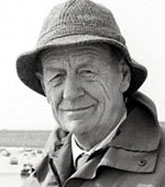
Born
1928
Died
2015
Publications
Novels, stories, plays
Writing language
English
Irish Literature
• Children of Dynmouth (1976)
• Fools of Fortune (1983)
• The Collected Stories (1992)
• Felicia's Journey (1994)
For love of characters
Modern authors can be a malicious lot. Like onlookers at accidents they often seem to thrive on watching their characters getting flattened by life's injustices, suffering mental anguish or being hurt, even killed.
Not William Trevor. The veteran Irish writer loves all his characters. Flattened, suffering or dying.
He loves them not in some naïve, goody-good way, but with an understanding that they are each central in their own stories. And from seeing—however unattractive, stupid or despicable they may seem on the surface—they each have some reason for forgiveness or some capacity for redemption. His stories and novels have this almost unique melding of contemporary, gritty, sometimes grisly, reality with old-fashioned humanism. His leisurely, no-nonsense writing style, a throwback to many years ago, maybe to Thomas Hardy or E.M. Forster (or in Canada to Morley Callaghan), enhances this softening, letting his beloved characters come to the fore.
And what a bunch of characters they are. Mainly from the humble fringes of British and Irish society—farmers, beggars, prostitutes, lonely seniors, store clerks, runaways, con artists—but also priests, country gentry, police officers and landlords. His tales just about burst at the seams with personalities who seem ordinary at first but develop into fascinating, even perverse, characters with dreams or fears that are too large to be contained in their straitened situations.
Ordinary people, extraordinary situations
A common theme for Trevor is his characters' acceptance or rejection of the abandonment of their hopes. Another is their small victories can turn out to be more meaningful than their original impulses.
But lest I give the impression his works are all rather dull character studies that are morally good for you to read, please note Trevor is also a brilliant plotter. His stories turn on ordinary characters involved in extraordinary situations. Once you are lulled by his gentle prose, the narratives can twist to catch you by surprise.
The word "poignant" crops ups in almost every review of his work, which indicates not just the creation of sympathy for his characters but his ability to draw them through situations that evince painfully sharp feelings in the reader.
He was born William Trevor Cox in County Cork, Ireland and educated at Trinity College, Dublin, although most of his adult life has been lived in Devon, England. His first novel, A Standard of Behaviour, was published in 1958. His first to win acclaim was The Old Boys (1964). This was followed by The Boarding House (1965), a surprisingly explosive story about the interwoven lives of boarding house tenants—in which the most important character dies on the first page.
Over the next three decades Trevor was prolific and we can scarcely list his award-winning novels, as well as his story collections that have led some critics to dub him the world's greatest living short story writer. His publications in this period include:
The Love Department (1966)
Mrs Eckdorf in O'Neill's Hotel (1969)
The Day We Got Drunk on Cake (stories, 1969)
Miss Gomez and the Brethren (1971)
The Ballroom of Romance (stories, 1972)
Elizabeth Alone (1973)
Angels at the Ritz and Other Stories (1975)
The Children of Dynmouth (1976)
Lovers of their Time (stories, 1978)
Other People's Worlds (1980)
Beyond the Pale (stories, 1981)
Fools of Fortune (1983)
Nights at the Alexandra (novella, 1987)
The Silence in the Garden (1988)
Juliet's Story (1991)
Two Lives (including the novellas Reading Turgenev and
My House in Umbria, 1991)
The Collected Stories (stories,
1992)
In 1994 he published what may be his greatest novel, Felicia's Journey, about a pregnant Irish girl who searches for her lover in England but is taken in by a strange older man. It's sometimes called a thriller and was made into an acclaimed film by Atom Egoyan.
Trevor continued publishing masterful stories and novels at the same pace into his seventies and eighties with:
Ireland: Selected Stories (1995)
Outside Ireland: Selected Stories (1995)
After Rain (1996)
Cocktails at Doney's: And Other Stories
(1996)
Three Early Novels (1997)
Death in Summer (1998)
The Hill Bachelors (stories, 2000)
The Story of Lucy Gault (2002)
A Bit on the Side (stories, 2004)
Cheating at Canasta (stories, 2007)
Love and Summer (2009)
He has also produced a collection of autobiographical essays, Excursions in the Real World (1993), has edited The Oxford Book of Short Stories (1989) and has written numerous plays stage, radio and television.
And, yes, his writing is morally good for you.
— Eric
Critique
