Erewhon
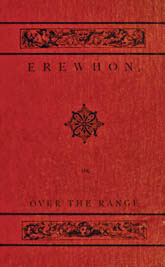 First edition
About the book
Author
Samuel Butler, England
Original title
Erewhon, or Over the Range
First publication
1872
Literary form
Novel
Genre
Literary, satire, science fiction, utopian
Writing language
English
Length
Approx. 89,000 words
Through a looking-glass darkly
I'm not sure we should even call Erewhon a novel. If it is one, it's a novel of ideas. Not like, say, one of Aldous Huxley's novels of ideas though. Great ideas don't play out among characters or decide the plot.
In Butler's Erewhon, characters are ciphers and narrative is an afterthought. They exist as an excuse to present an alternative society and let the author comment on it. Or, rather, to give the author a chance to present his own ideas as though they are someone's else's.
There is a bit of narrative framework, a few chapters about how Butler's narrator stumbles onto the land of Erewhon (an anagram for "nowhere") somewhere near southeast Asia. (It sounds geographically like New Zealand where Butler once resided.) And there's an adventurous escape by balloon near the end.
But Erewhon is really more a work of philosophical, religious and scientific speculation. The novel is often called dystopian—as it purports to describe a bad imaginary society—but Butler is more concerned with showing us our own world. Each aspect of the ridiculous nature of the state of Erewhon has its counterpart in our own society, or at least in Western societies of Butler's time.
Sometimes the comparisons point up opposites between our world and Erewhon, as in Erewhonians' condemnation of sickness as immoral and criminal, while they are quite understanding of what we would consider criminal activity, like theft. Sometimes the differences are near-parallels, as in the mystical belief Erewhonians have in a before-life of the unborn, while most citizens of our world hold out hope for an afterlife.
In both cases, the intent is to point up how illogical our own attitudes are. Butler makes no attempt to explain how a society like Erewhon could function with such bizarre laws and economics.
Religious skepticism
Sometimes he just seizes the opportunity to put his own theories into other people's mouths. Religion is one of the two great topics that absorb him. Butler is still a Christian while writing Erewhon but in defending his beliefs to Erewhonians he reveals to us they are no more justified than the strange creeds of those upside-down people. The all-out criticism of Butler's The Way of All Flesh is still a few years away but we see him expressing doubts in Erewhon. Religious skepticism plays a role throughout the story, being evident even behind the long exposures of the Erewhonian banking and educational systems.
Butler's other prime target is Darwinian evolution. He's no creationist though. During the period of great intellectual upheaval in the latter nineteenth century, Butler sided with the evolutionists but came up with a variation on Darwin's theory that allowed the inheritance of habits. This would become full-blown in Butler's later nonfictional works, which are probably best left forgotten, but here he just hints at it.
He also recycles an earlier piece he had written about the rise of intelligent machines in the future, attributing it to an Erewhonian philosopher, and in a similar fashion goes on about consciousness in animals and plants. Interesting stuff—much of it outdated but some of it still profound.
The hard truth is that much of Erewhon is very dull reading. If you want a juicy story, forget it. You really have to be interested in the ideas he raises to get much out of this so-called novel.
Yet Erewhon has lasted well into its second century while other utopian and dystopian fantasies of that fertile era—and since—have come and gone.
It appears Samuel Butler's ideas are of interest well beyond the religious and scientific concerns of the 1870s.
— Eric
See also:
Buy the book:
X (Twitter):
