Hebrew Bible (Old Testament)
Critique • Other views • Quotes • Text • Biblical canons
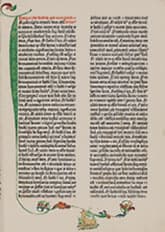
"Genesis" first page, Gutenberg Bible, 1455
About the book
The authors
Unknown, Israel, Judah and Babylon
First publication
c.1200–100 BCE
Form
Prose and poetry
Genre
Religion, mythology, history
Writing languages
Hebrew and Aramaic
Length
Approx. 632,500 words (Old Testament, King James Version)
Other views of the Bible as literature
Matthew Arnold
The language of the Bible, then, is literary, not scientific language; language thrown out at an object of consciousness not fully grasped, which inspired emotion. Evidently, if the object be one not fully to be grasped, and one to inspire emotion, the language of figure and feeling will satisfy us better about it, will cover more of what we seek to express, than the language of literal fact and science ; the language of science about it will be below what we feel to be the truth.
The question however has arisen and confronts us: what was the scientific basis of fact for this consciousness. When we have once satisfied ourselves both as to the tentative, poetic way in which the Bible personages used language, and also as to their having no pretensions to metaphysics at all, let us, therefore, when there is this question raised as to the scientific account of what they had before their minds, be content with a very unpretending answer. And in this way such a phrase as that which we have formerly used concerning God, and have been much blamed for using—the phrase, namely, that, "for science, God is simply the stream of tendency by which all things fulfil the law of their being"—may be allowed, and even prove useful.
— from Literature and Dogma, 1873
Richard G. Moulton
It is natural to enquire, What are the leading literary forms under which the sacred writings may be classified?
A large proportion of the Bible is History: the History of the People of Israel as presented by themselves. How Israel is chosen from all the nations to be the special people of Jehovah; how the invisible Jehovah is at first their only ruler; how gradually the spirit of assimilation to surrounding nations leads to a demand for visible kings. Just as this tendency to secular kingship becomes strong, there comes into prominence an order of "prophets": the word signifies "interpreters," and the prophets are accepted as the interpreters of Jehovah's will to Israel. Under such rule as that of David, the man after God's own heart, the work of the prophets may fall into the background; but where, as usually happened, the secular government tends to ungodliness, the order of prophets stands forth as an organised opposition. On lines like these the historic narrative of the Bible pursues its course; and with the thread of narrative are interwoven legal and statistical documents which give it support....
From History we must, in literary analysis, distinguish Story: the one is founded on the sense of record and scientific explanation of events, the other appeals to the imagination and the emotions. The Story literature of most peoples is 'fiction,' in the sense that its matter is invented solely for literary purposes. The stories of the Bible are part of the sacred history, differing only in the mode in which the matter is presented; and a long series of these stories is scattered through the historical books, with nothing to distinguish them, in the ordinary versions, from the historic context....
One book that has a place in the historic sequence of the Bible introduces us in reality to a different class of literature—Oratory. Deuteronomy is made up of the Orations (and Songs) of Moses, constituting his Farewell to the People of Israel. It is oratory in the fullest sense of the term, representing the words as they may be supposed to come direct from the speaker. For the most part however the sacred literature of oratory is of a different kind; not exact reports of spoken words, but the substance, it may be, of several similar speeches worked up afresh into a form of written discourse. In this wider sense, the oratorical literature of the Bible is of considerable extent; it includes the prophetic discourses, and reflects the fervid contests over first principles of righteousness which constituted the main life of Israel....
Philosophy has an important place in Scripture. The word however is not there used to describe a division of literature, but the sacred philosophy is called "wisdom"—a term suggestive of its close application to matters of human life and duty. This Wisdom literature started from the "proverbs"—simple thoughts conveyed in a couplet or triplet of verse, which were collected together by King Solomon and other of the wise men of Israel. From these proverbs the form of wisdom enlarged to verse epigrams and sonnets, or prose maxims and essays, until we find books of wisdom comprehending complete systems of thought. To catch the development of this Wisdom literature, it is necessary to take in two books of "The Apocrypha"; a portion of sacred Scripture which in the last century used to be bound up with Bibles, standing in its historical position between the Old and New Testaments, though now it is usually separated. In theology, which is concerned with questions of authority, the distinction between the Bible and the Apocrypha is fundamental: the one is accepted as authoritative in matters of faith, whereas the Apocryphal books are merely recommended for devout reading. But in literary study the distinction disappears; and two books of the Apocrypha are of the highest literary importance—Ecclesiasticus and The Wisdom of Solomon.... The Proverbs is a Miscellany of Sayings and Poems, embodying isolated observations of life. Ecclesiasticus is a Miscellany including longer compositions, but still embodying only isolated observations of life. In Ecclesiastes we find a connected series of writings, in which attempt is made to solve the mystery of the universe: but the attempt breaks down in despair. The Wisdom of Solomon renews the attempt in the light of an immortal life beyond the grave, and despair yields to serenity of spirit. The four books thus reflect a philosophical advance. In The Book of Job—one of the world's literary marvels—men's varying attitudes towards the mystery of life are represented in various speakers, and drawn together into a unity by the movement of a dramatic plot....
Biblical Lyrics may be mentioned next. Originally, all poetry was spoken with musical accompaniment; when this primitive literature began to divide up into specialised forms, Lyric was the literary form which retained most of the spirit of music. It includes Songs and Odes, in which the very structure of the poem is determined by the mode of its performance; Psalms and Lamentations; the Traditional Poetry scattered through the historical books; again, considerable portions of prophetic literature are found to take a lyric form....
Of the fundamental divisions of literature there yet remains one—the Drama. The relation of this to the Bible is interesting. It is impossible to read the scriptures of the Old Testament without feeling that the genius of the Hebrew people is strongly dramatic. Yet the natural instrument for the expression of dramatic creations—the theatre—is not a Hebrew institution. Accordingly the dramatic instinct, denied its readiest outlet, is found to leaven all other literary forms. We have already noticed dramatic wisdom in Job. Dramatic lyrics are found, not only in some of the psalms, but on a larger scale in the love songs of Solomon. But there is a more important type of dramatic literature in the sacred Scriptures. The prophets of Israel were not only statesmen and preachers, they were also poets, and from them has come down to us a form of spiritual drama to which may be given the name "Rhapsody."
These spiritual dramas of the prophets are occupied with that fundamental topic of Hebrew thought which is expressed by the word "judgment": the eternal contest between good and evil, and the Divine overthrow of wrong. They are dramas which no actual theatre could ever express, for their action covers all space and all time. Their personages include not only the prophet and the nation of Israel, but also God himself and the celestial hosts. The working of events towards the judgment is brought out before us with the general impression of dramatic movement; but the means by which this movement is realised go beyond the machinery of drama: not only dialogue and monologue, but song and even discourse are made to bear their part in the total effect. The grand example of rhapsody which covers the latter part of our Book of Isaiah can be represented in the present volume only by its prelude and one of its seven acts or "visions"....
I believe few people realise what an immense addition has been made to the literary patrimony of the English reader by the Revised Version of the Bible, and such other presentations of the sacred Scriptures as this Revised Version has made possible. The language of Biblical writers, and the sentences of which their writings are made up, have long been familiar through the earlier versions; the Revisers, by the attention they have given to connectedness of thought, have carried forward translated language into translated literature. It is thus open to a person of average culture to add to his other mental possessions the whole expression of itself which a great people has made in poetry and prose throughout all the periods of its development. With the exception of humorous writing, which is foreign to the genius of the ancient Hebrews, the whole range of literary production is here illustrated; and varieties of literary form are presented to which classic Greek or modern European writers furnish no parallel. It is a literature numbering among its authors some who—by critics entirely outside the ranks of theologians—have been classed with the greatest names in the world's roll of honour. More than this, the English reader who gives attention to the literary side of the Bible is studying what is to him ancestral literature. The Hebrew writers of the Old Testament, and their followers the Christian Hebrews of the New Testament, have been the inspiration of those who have inspired our own writers: their style has largely leavened the style of modern English, their thought has become so closely interwoven with English thought of the last three centuries that it is impossible to sever the two. And, if the question be of what is higher than literary impressions, no reader need fear that the more sacred uses of the Bible will be imperilled by his reading, not with the spirit only, but with the understanding also.
— from Select Masterpieces of Biblical History, 1897
G.K. Chesterton
The English translation of the Bible has one real claim to be English. Many of the eulogies about its Protestant purity and its Anglo-Saxon empire-building are partisan and fantastic. But it is in this immense sense national, that it is anonymous. The translation, as a translation, is as English as the ballads about Robin Hood, which were written by everybody and nobody. It is true that the learned bishops and dons who translated it were far from regarding themselves as nobodies. But in the history of English literature they are nobodies; only they are immortal nobodies. It is impossible to point to a single great man who is responsible for this masterpiece of verbal music. At the very time when the translation was being made there were in England greater literary men than she is ever likely to see again. But by no conceivable trick or turn of circumstance can Bacon, Burton, Jonson or Shakespeare, have had anything to do with the translation of the Bible. It was done by a mob of bishops; that is, a mob of simple and well-meaning men. The enemies of the Bible have been heard to describe it as Jewish folklore; of course, in a bad sense. In any case, our translation is English folk-lore—and that in the best sense. England wrote it; no mere Englishman could have done so.
"How beautiful upon the mountains are the feet of him that bringeth good news." That is a light and as leaping and as classically pure as Spenser. But Spenser had nothing to do with it; some ordinary parson wrote it.
"And his driving is as the driving of Jehu, the son of Nimahi; for he drives furiously." That is far more vigorous than Chapman or Ford. But Chapman and Ford had nothing to do with it; it was done by some common clergyman.
"Where there is no vision the people perish." That is as plain and picturesque as Bunyan. But Bunyan had nothing to do with it; in fact, he was not born. It may seem a strange matter that these pompous big-wigs summoned by so stiff a Scotch pedant as James I should be ultimately urged as an argument for popularism and the populace. And yet they are one of its strongest arguments. They show how well quite commonplace people can write when they are writing about something that is not commonplace.
That is the plain element of patriotic importance in the translation. It is the last collective creation of our people. It is the last case in which everybody reads the book and nobody asks the author. After that England left off writing. Englishmen rushed into the breach and tried to write, not altogether without success. Milton, Dryden, Addison, Dr. Johnson, made a very good show of it. But almost at once they were flooded by forces not English; by Irishmen like Swift and Goldsmith, by Scotchmen like Hume and Scott. We are right to treat this book, even as an English book, as authoritative. It may or may not record the real origin of the Jews; but I am sure that it records the real end of the English.
There comes a perfect moment when there is no difference between language and literature. Prose is poetry without knowing it; it is as if an absent-minded poet always said good morning in metre, or asked us to pass the potatoes in impromptu and unconscious rhyme. Imagine that we all talked poetry all day long; suppose we asked for a ticket with a triolet; suppose we used a poet-card only for the purpose (which its shape obviously suggests) of writing a sonnet. Suppose, whenever we talk about the weather, we talk as Shelley wrote about the weather. Suppose, whenever we use a term of affection, it is like one of the great love songs. If we fancy some such condition, we may begin to imagine what really happens when a language is in its perfection. Everything said goes to an inaudible tune; as to a march of totally muffled drums. The poetry has got inside the prose of life, and moves all its limbs into a rhythm and beat of beauty.
The English of the English Bible is not merely splendid about splendid things; it is splendid about everything. In any modern leading article we might see the words "We cannot understand why English watering-places like Bath or Brighton are not as adequate as foreign watering-places like Baden or Dieppe; nor why those who seek the one should not as reasonably seek the other." And that would be perfectly good modern English. It is not mere religious association that makes us see better English in "Are not Pharpar and Abanah, the waters of Damascus, better than all the waters of Jordan, and may I not wash in them and be clean?" It is really the perfection of style; it is poetry inside prose.
— from "The Great Translation", Daily News, 1911
A.D. Howell Smith
Although our ignorance of what has perished forbids us to dogmatize, it may well be that the Bible contains the cream of what the poets and the historians of Western Asia created over two thousand years ago. Probably no other prophet arose in that ancient world who ever soared into Isaiah's empurpled heaven, or who ever pleaded with such eloquence of stern compassion as burst from the tortured heart of Hosea, just as out of the many meritorious English dramatists of the Elizabethan and Stuart periods none ever attained to the amazing greatness of Shakespeare. But ethical and literary transcendence cannot be claimed for all the contents of the Bible. Many of its pages are poor stuff from the literary or the educational standpoint, though even poor stuff may possess a considerable value for the archaeologist and the student of folklore.
Bias largely determines our evaluations. In the eyes of passionate pietists the literature of ancient Israel, at any rate whatever of it has entered the Canon, outweighs everything that ancient Hellas ever produced. But many good judges of what constitutes fine literature will prefer the Iliad and the Odyssey to the Book of Genesis. If the story of Joseph touches us to tears, the same can be said of the tale of the wayworn Odysseus, restored after so many years to his faithful wife Penelope, and of the delicate picture of the last leave-taking of Hector from his wife and his baby boy. Who would be sorry if the gross myth of Lot and his daughters had been displaced by the lovely tale of the encounter of Odysseus with Nausicaa and her merry maidens? Homer's warriors are not more ruthless than those of the Book of Judges; their not infrequent decency and humaneness can be set against their lust for blood.
In the later products of Hellenic thought we find depths sounded that were seldom imagined by the Hebrew brain. Aeschylus, Sophocles, and Euripides, with their dramatization of eternal ethical principles in a rich variety of time-settings, may be weighed in the balance with the scolding prophets of Israel, and on an impartial estimate it seems hard to decide with which nation the moral superiority finally lies. We are indebted both to the Greek classics and to the Bible for the values that are wrought into our civilization. As Matthew Arnold loved to remind us, a culture that is sanely ethical must be both Hellenist and Hebraist.
Plato's metaphysical flights give us something the Bible does not supply. The epic of Socrates as told in the Phaedo and The Apology lifts us into "a nobler ether, a diviner air" than anything the Old Testament relates of the last days of its heroes. There is, to be sure, dignity and pathos of the highest kind in the story of the Crucifixion; but it exhibits a "failure of nerve" from which the passing of the Sage of Athens is free. Only by a strange theological interpretation, which forces horror into the jaws of absurdity, can the bitter death-cry, "My God, my God, why hast thou forsaken me?" be made to wring more than an embarrassed pity from our hearts.
Where among the ancient Hebrews shall we find the encyclopaedic and constructive brain of Aristotle, "the master of those who know," as Dante calls him? What the Bible tells us of the wisdom of Solomon suggests the typical Oriental exaggeration of a Sultan's shrewdness and inquisitiveness. Solomon may not have been wiser than Akbar the Great, if so wise. Perhaps his wisdom is a myth.
Cleanthes' Hymn to Zeus is as serene as any poem in the Psalter, and breathes a calmer and a broader piety. "Thou makest order out of disorder, and what is worthless becomes precious in thy sight; for thou hast fitted together good and evil into one, and hast established one law that lives for ever."
In the Books of Samuel and Kings we find many pages of beauty and vivid imagination. But the Hebrew historians are remoter from those of the modern world than is the great Thucydides, who strives after an objectivity to which the ancient East was a stranger.
"Slowly the Bible of the race is writ." From the harsh and bloodthirsty war-songs of the savage to the sustained harmony of Milton, the "organ voice of England," from the jejune and drearily repetitive records of the Babylonian chronicler to the magic pages of Gibbon, from crude stories of banshees and ghouls to the delicate fancies of Hans Andersen, from the halting philosophizings of ancient Hebrew and Egyptian sages to the metaphysics of Spinoza and Hegel what an evolution! If this human inheritance does not content us, if we must yearn after infallible oracles and regard as contemptible the flickering light of a reason that can claim no illumination from above on the dark and tangled pathway of the illogical, if we fear that to break free from the shackles of sacred books and creeds may one day thrust us into the everlasting bonfire, then we may turn aside from the perilous task of Rationalism and be comforted by the knowledge that churches and temples await us still, with rites and dogmas to silence all our doubts. Yes, we can obstruct the vital urge of the human intellect and the human will; but in so doing we shall become the agents and the victims of innumerable cruelties and oppressions.
— from In Search of the Real Bible, 1943
Mortimer J. Adler
No other book in the Western tradition has been subject to such extensive interpretation. This is due to its unique status as a text that is, for millions of readers, not merely a human document but the literal Word of God. As a result, the history of its interpretation is split into two irreconcilable traditions. On one side stands the tradition of faith, which approaches the text through sacred exegesis, viewing it as a unified, divinely inspired revelation. On the other side stands the modern tradition of higher criticism, which treats the Bible as an historical artifact—a collection of disparate texts to be analyzed with the same secular, literary, and historical tools one would apply to Homer or Cicero.
— from Great Books of the Western World, 1952
Northrop Frye
It took me some time to hit on the right formula for a course in the Bible. I consulted the curricula of other universities, and found that they gave courses called "The Bible as Literature", which involved chopping pieces out of the Bible like the Book of Job and the parables of Jesus and saying, "Look, aren't they literary?"....
So I had to go on to the next stage, which was to establish that there was a genuine unity in the Bible, and that that unity was of two kinds. The first was a unity of narrative.... It starts quite logically at the beginning of time with the Creation, it ends quite logically at the end of time with the apocalypse, and it surveys the whole of human history—or the part of history that interests it....
The second way in which the Bible is unified is through a number of recurring images: mountain, sheep, river, hill, pasture, bride, bread, wine and so on. They echo and re-echo all through the Bible and are repeated in so many ways as to suggest that they have a thematic importance: that they are actually building up some kind of interconnected unity.
— from The Bible and English Literature lectures, 1982
Critique • Other views • Quotes • Text • Biblical canons
See also:
Buy the book:
Hebrew-English Tanakh (Hebrew Bible)
Holy Bible: King James Version
X (Twitter):
