'Nightfall'
Critique • Quotes
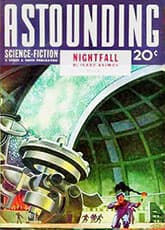 First appearance in magazine
About the story
Author
Isaac Asimov, United States
First publication
1941
Form
Story
Genre
Science fiction
Writing language
English
Length
Approx. 13,000 words
The shorter the nightfall the better
First a word about the versions of this story. The 1941 short story "Nightfall" has been acclaimed one of the greatest science fiction tales—if not the greatest science fiction tale—ever. You can find it in many anthologies, including Asimov's The Complete Stories and Nightfall and Other Stories, as well as in collections of classic sci-fi, such as the Science Fiction Hall of Fame, Volume I, edited by Robert Silverberg.
The novel Nightfall was expanded from the story in collaboration with the same Robert Silverberg in 1990. It was a mistake.
By dragging out the story without adding any depth to the characterizations, the longer form dilutes the poetic intensity of the original sharp story.
The novel also highlights a major wimp-out in the promising theme of religion versus science. Asimov himself was reportedly pleased with the novelization, saying it was absolutely faithful to his original story, but I'm not sure extending the original concept over more pages is a good thing in this case. Some ideas are dramatically just right for the short treatment.
Into darkness
The concept of "Nightfall", the short story, is simplicity itself. A planet with six suns is always bathed in light, as the sky is never without at least one sun in sight—as far as its inhabitants have known.
However, a once-every-two-thousand-years eclipse threatens to throw the planet into unaccustomed darkness. That's it for plot pretty well, except for the battle of a brave, young scientist against his blinkered superiors and the superstitious panic of the ignorant masses.
The story's impact comes from the psychological effect on the people of the growing darkness.
And then...one unexpected phenomenon.
The story has been adapted for at least two films and the concept of a fearful world facing prolonged darkness has been borrowed for others.
Read the novel if you want, but try the short story first. The compact form is perfect for showcasing the tale's cleverness and its sense of despair, without revealing its weaknesses. For those, you can move up to the novel.
— Eric
Critique • Quotes
See also:
Buy the book:
X (Twitter):
