The Foundation Trilogy
Critique • Quotes • At the movies
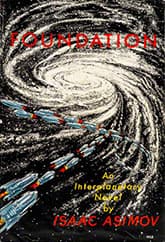 First work in the series, first edition
About the books
Author
Isaac Asimov, United States
First publication
As stories in Astounding Science Fiction magazine
First book publication
1951 (Foundation)
Form
Novels
Genre
Science fiction
Writing language
English
Original trilogy:
• Foundation (1951)
• Foundation and Empire (1952)
• Second Foundation (1953)
Sequels:
• Foundation Edge (1982)
• Foundation and Earth (1986)
Prequels:
• Prelude to Foundation (1988)
• Forward the Foundation (1993)
Galactic puzzles within puzzles
In the 1980s Isaac Asimov reread the Foundation stories he had written in the 1940s and had compiled as a trilogy of books in the 1950s, and he was appalled. The stories had no action, no suspense, no romance—they were all thought and dialogue. Yet he found them involving. Even though he was the author, he wanted to read more.
So he says in an introduction that appears in later editions of the books. He may also be describing the reaction of many readers. These are very talky, ruminative stories.
There is big action. A galactic empire starts to crumble. Psychohistorian Hari Seldon establishes a repository of science and knowledge in a foundation at the edge of the galaxy, supposedly to speed humankind's recovery from the coming dark ages. Local warlords fight for power. The foundation's existence is threatened. Charismatic figures seize power.
All kinds of action occurs on a large scale. But they aren't at the centre of the books. So what is?
Large-scale imperialism
Much of the commentary on the Foundation series has to do with two themes it introduced—or at least popularized—in speculative fiction. The most influential has been the extension of the genre's world building to entire galaxies. Asimov used the history of the Roman Empire as a rough model for the rise and fall of his galaxy-spanning empire. Galactic empires—encompassing thousands of local systems and gazillions of subjects, not to mention continual rebellions and rivalries from other would-be rulers—have been described in numerous science fiction series since Foundation.
And many of these empires, like Asimov's, feature feudal-style monarchs at the top while functioning more like capitalist enterprises gone wild—monopoly capitalism in its imperialist phase. (Doesn't it seem strange that so many visions of the technologically advanced far future seem to require the cover of musty old clichés of kings and queens.)
Then there's Asimov's more intriguing, if less influential, notion of psychohistory, the fictional science of using math and statistical analysis to predict the future. Psychohistorian Hari Seldon appears throughout Foundation, in person initially and holographically after his death, to check the empire's decline and the foundation's progress against his predictions. The accuracy of psychohistory is meant to underline Asimov's hypothesis that historical developments involving large masses of people follow set patterns that can be predicted, though extraordinary individuals can cause unforeseeable perturbations.
The character Seldon can be seen as an alter ego for Asimov himself, the author manipulating events from behind the scenes to create a path through the movements of inevitable history to reach his desired conclusion. Seldon's/Asimov's creation of the foundation and his appearances at points of crisis for the foundation's future are part of how he manages this. But eventually it is revealed he has another fallback. He's secretly created a second foundation.
A huge mystery is set to be unravelled: the quest for the second foundation that Seldon posthumously reveals he had set up at the opposite end of the galaxy. What Seldon meant by "opposite end" is not so easy to determine. Each of the books in the original Foundation Trilogy (that is, Foundation, Foundation and Empire, and Second Foundation) solves the evolving mystery in a way that trumps the previous book.
Actually there are more than three puzzles worked out. The trilogy was made from eight stories, plus an introduction Asimov wrote to detail the first three hundred years of the Foundation saga. (This is what writers call a fixup, turning linked stories into novels.) So in each book of the trilogy you get two to five chunks of the mystery, often presenting lines of thought that appear confirmed and then discarding them as new solutions to the Seldon mystery are worked out in history.
Somehow it is a thrilling and mentally stimulating ride. A page turner. Small wonder the trilogy was awarded the Hugo award for best series of all time in 1966, beating out The Lord of the Rings.
Expanding the universe
Each of the books added to the series after the trilogy is also involving in its way, but successively less so. Foundation's Edge, written four decades after the first Foundation story, took the saga to another level. Foundation and Earth finds the ultimate solution but suffers from Asimov trying to fit it in with the other science fiction worlds he had created.
The last two Foundation books, Prelude to Foundation and Forward the Foundation, are prequels, outlining Hari Seldon's struggle to launch his Foundation project. To be chronologically correct, it may seem sensible to begin reading the series with these—but don't! These are the worst written and, without the foundational mystery to solve, the most boring of the lot. They reek of an author creating a memorial.
My advice—similar to that I give for Philip José Farmer's great Riverworld series or Frank Herbert's ever-growing Dune universe—is to start reading the books in the order they were written and read as far into the series as you enjoy. You may be satisfied with the trilogy. Or you may, like most readers, feel the need to race through to the final answer of the fifth book. Or you may become so hooked by the world Asimov created that you'll take even third-rate Foundation in the form of the two prequels.
You might even enjoy some stories by other science-fiction writers set in the Foundation universe. Orson Scott Card wrote "The Originist" about the founding of the second foundation, which is collected in an anthology tribute to Asimov.
There are few earth-shaking ideas in the Foundation books. Nothing that greatly moves or inspires me as I go about my daily existence. Not consciously, at least.
But, for some reason, I've read the original trilogy at least twice (and the rest of the series at least once), and one of the pleasures I have to look forward to, if I live long enough, is to get lost in the Foundation saga again.
— Eric
Critique • Quotes • At the movies
See also:
Buy the book:
Foundation; Foundation and Empire; Second Foundation (boxed set)
X (Twitter):
