Anna Karenina
Critique • Quotes • Translations • At the movies
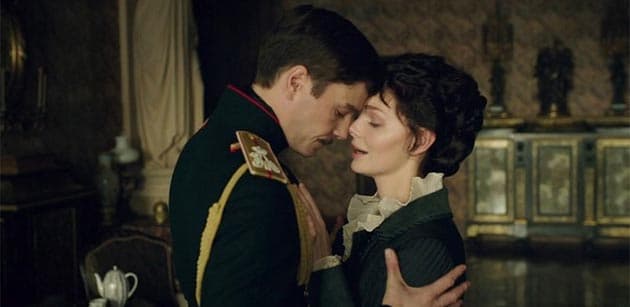
Maksim Matveyev and Elizaveta Boyarskaya are the ill-fated lovers in Anna Karenina: Vronsky's Story.
A love story recalled
Anna Karenina: Vronsky's Story (2017): Television miniseries 360 minutes, film version 138 minutes; director Karen Shakhnazarov; writers Shakhnazarov and Yuriy Poteenko; featuring Elizaveta Boyarskaya, Maksim Matveyev, Vitali Kishchenko, Dimitriy Gusev, Viktoriya Isakova, Kirill Grebenshchikov
Some may doubt whether this Russian production really counts as an adaptation of Anna Karenina. The six-hour television series, subtitled Vronsky's Story, follows only one storyline of Tolstoy's massive novel—the ups and downs of Anna's illicit love affair—and purportedly only from her lover's perspective.
Vronsky's relating of the story takes place thirty years after the events of the novel when he meets her son in a Manchurian field hospital during the Russian-Japanese war. Wounded officer Vronsky is treated by Sergey, now a doctor, and is pressed to recount what led to Anna's death. This setting becomes more than just a framing device but a separate story, as Vronsky works through his guilt over Anna and inexplicably develops a protective friendship with an unspeaking young Chinese girl.
The Japanese war sequences are based not on anything Tolstoy wrote but supposedly on memoirs by Russian doctor Vikenty Veresaev—with Vronsky and Sergey dropped in.
On paper this reimagining of Anna Karenina might seem intriguing. But it doesn't work out that way. The "present-day" scenes are needlessly elaborated, coming to feel like continual interruptions to the telling of the main romantic story.
Worse, the main romantic story itself becomes tedious. The Levin-Kitty storyline, which plays a comparing and contrasting role in Tolstoy's novel, is removed to give the Anna-Vronsky tale more space. But this space is taken up with long, repetitious dialogues between any pair of the central characters, verbally delving into every minor twist of plot and nuance of thought.
Scenes from 1948 film Anna Karenina set to the "Anna Karenina Overture".
The camera loves popular Russian actress Elizaveta Boyarskaya and she does her best as Anna. Yet, in this production, the character can't help but become annoying. She's a mess of contradictions—caring and selfish, perceptive and idiotic, loving and hateful—changing from one state to another more quickly as she descends toward paranoia. And without stirring any real emotion in our hearts.
Vronsky has our sympathy as he tries to deal with this impossible lover. He remains calm and impassive in the face of her most ridiculous attacks. It's hard to understand why he is still haunted by her decades after her demise. As played by Maksim Matveyev (who is married to Boyarskaya in real life), Vronsky himself seems confused about why he continues to care.
Anna's legal husband, Karenin, is given a large amount of screen time, allowing actor Vitali Kishchenko to show the older man's own inner conflicts, though less colourfully. He too suffers from a script that never lets Karenin settle into being either an honourable or monstrous character, but keeps switching between them.
Vronsky's Story looks great though. From the sumptuous ballrooms, artistically decorated offices and palatial residences to the rugged field hospital scenes, the visual production is outstanding.
Too bad we didn't have equally fascinating stories and characters to inhabit those sets.
— Eric
Critique • Quotes • Translations • At the movies
See also:
Buy the book:
Anna Karenina, trans. Luise and Aylmer Maude
Anna Karenina, trans. Pevear and Volokhonsky
X (Twitter):
