Dalziel and Pascoe series
Critique • Quotes
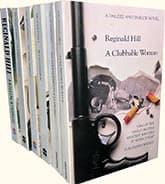 Paperback editions, starting 1987
About the books
Author
Reginald Hill, England
First publication
1970–2009
Form
Twenty-three novels, one novella and story collection
Genre
Crime, mystery, detective
Writing language
English
• A Clubbable Woman (1970)
• An Advancement of Learning (1971)
• Ruling Passion (1973)
• An April Shroud (1975)
(re-titled "An Autumn Shroud")• A Pinch of Snuff (1978)
• A Killing Kindness (1980)
• Deadheads (1983)
• Exit Lines (1984)
• Child's Play (1987)
• Under World (1988)
• Bones and Silence(1990)
• One Small Step (story and novella collection, 1990)
• Recalled to Life (1992)
• Pictures of Perfection (1994)
• The Wood Beyond (1995)
• Asking for the Moon (short stories) 1996)
• On Beulah Height (1998)
• Arms and the Women (1999)
• Dialogues of the Dead (2002)
• Death's Jest-Book (2003)
• Good Morning, Midnight (2004)
• The Death of Dalziel (2007)
• A Cure for All Diseases (2008)
• Midnight Fugue (2009)
The seriously entertaining detective novels
This is how it's done.
Many crime and mystery writers have tried to merge their genre work with literary fiction. They've spun paragraphs describing nuances of setting, decor, dress or personal appearances. They've added long and allusive internal monologues. They've presented their detective protagonists as finely cultured figures—aristocrats, scholars, poets even.
Despite the literary elements turning their narratives turgid, some have won critical plaudits as "serious" writers and drawn high-minded readership.
Reginald Hill on the other hand has succeeded in making the novel series featuring his team of Yorkshire detectives a literary delight without giving up any of the suspense, shock or humour the mystery genre can afford.
Hill's lead figures are quickly drawn in the initial titles, A Clubbable Woman (1970) and An Advancement of Learning (1971). Crude, fat slob Andy Dalziel is a loud-mouthed reactionary and misogynist. Polite, sophisticated university graduate Peter Pascoe is a thoughtful, bleeding-heart liberal. As least they seem so at first. A typical movie-type pairing of ill-matched partners, you might think. Dalziel (pronounced Dee-ELL) the experienced old-style, intuitive cop and Pascoe the young, new-school, analytical cop. And if this were any other writer, that's the dynamic the characters would continue to serve as they stumble together through their investigations.
And in part they do. But only in a small part. It turns out these early novels are the least in the series, only the starting points for evolutions in our appreciation of the characters.
Shifting perspectives
As the series progresses, Dalziel and Pascoe are revealed to comprise many unguessed contradictions and unsuspected depths. They grow over time. They change. They swap places. They ebb and flow. Interesting supporting characters develop equally. Pascoe's wife Ellie, the novelist and political radical. Sergeant Wieldy, the closeted gay man, magnificently ugly, moody and efficient. Attention keeps shifting among their perspectives. We start getting Dalziel novels and Pascoe novels, plus stories focused on Ellie, Wieldy or any of the other characters in the police force, community or criminal world. We get at least one investigation (Deadheads, 1983) seen mainly—and sympathetically—through the killer's eyes.
All this character work and all this getting inside of heads slows down the stories hardly bit. Hill shows narrative can be driven simultaneously by character and plot. Deep and superficial thoughts are dispensed alike in short, intriguing paragraphs. Dialogue swings between clever and earthy. Themes are both intellectually befuddling and street-level thrilling.
Admittedly, Hill does delve a little too far into literary and dramatic themes in a couple of his mid-series novels. In the highly regarded Bones and Silence (1990), the investigation is entangled with a local production of medieval mystery plays—playing on the old sense of "mystery" as referring to Biblical miracle stories, comparing the handling of sin, confession and retribution in religion and in police work. In Arms and the Woman (1999) the account of the criminal investigation is interspersed with passages from a humorous rewriting of Homer's Odyssey by novelist Ellie.
Hill though seems aware of how heavy this is and has his built-in Falstaff handy to deflate intellectual pretensions as needed. In the mystery plays, for example, Dalziel hilariously ends up playing God. And in Ellie's satirical novel it becomes apparent her Odysseus is based on the fat man.
Never stale
In many other novels, Hill plays with novel structure and challenges reader expectations to spice up what might otherwise settle into becoming stale police procedurals.
Death's Jest-Book (2003), probably the least popular but critically praised novel in the series, devotes much of its text to long philosophical letters to Pascoe from psychopathic academic Franny Roote, this being the fourth time Roote has appeared as a suspect of sorts.
Readers of Dalziel and Pascoe novels often learn more about the real killers than the detectives do. The privileged information can extend even beyond the conclusion of cases. Sometimes we are led to wonder whether the cops got the right person. Sometimes we know they didn't.
Then there's the story-within-the-story or the parallel-plot formats, both of which I usually dread—you just get going in one narrative stream and then abruptly have to switch to another and then back again until the multiple stories finally converge—though Hill does handle these literary styles well and most readers will find them, like all his writing, highly readable.
Hill also likes to play with time. Sequences are often mixed up, though we are given enough clues to figure out the course of events without massive confusion.
The last Dalziel and Pascoe novel, Midnight Fugue (2009) lays out the story sequentially, but it takes place over one day, with characters alternating in time-stamped, overlapping chapters.
In the most radical break from the usual mystery genre plot, the novella One Small Step (1990) takes a future Peter Pascoe into space to solve the first murder on the moon.
As innovative as Hill gets in the Dalziel-Pascoe series, he remains in control of his stories. If they end ambiguously or with loose ends dangling, it's not because the author's negligent but because he purposely wrote them that way to make you think or feel something beyond the satisfaction of another closed case for our heroes.
Hill is the master of circular plots that seem to be pointing wildly in different directions but finally fold in upon themselves. They may not ultimately coalesce as you expect but how they do is usually more interesting.
— Eric
Critique • Quotes
See also:
Buy the book:
X (Twitter):
