The Gnostic Gospels
Critique • Quotes
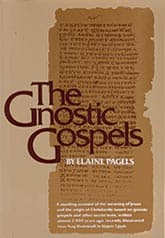 First edition, 1979
About the book
Author
Elaine Pagels, United States
First publication
c.300 BCE
Form
Nonfiction
Genres
Religion, history
Writing language
English
Length
Approx. 50,000 words
Notable lines and passages
In December 1945 an Arab peasant made an astonishing archeological discovery in Upper Egypt.
— First line
Abandon the search for God and the creation and other matters of a similar sort. Look for him by taking yourself as the starting point. Learn who it is within you who makes everything his own and says, "My God, my mind, my thought, my soul, my body." Learn the sources of sorrow, joy, love, hate. Learn how it happens that one watches without willing, rests without willing, becomes angry without willing, loves without willing. If you carefully investigate these matters you will find him in yourself.
— Monoimus quoted by Hippolytus of Rome, translated by Pagels
We now begin to see what we call Christianity—and what we identify as Christian tradition—actually represents only a small selection of specific sources, chosen from among dozens of others.
It suggests that these religious debates—questions of the nature of God, or of Christ—simultaneously bear social and political implications that are crucial to the development of Christianity as an institutional religion. In simplest terms, ideas which bear implications contrary to the development came to be labeled as "heresy"; ideas which implicitly support it become "orthodox."
But in terms of the social order, as we have seen, the orthodox teaching on resurrection had a different effect: it legitimized a hierarchy of persons through whose authority all others must approach God. Gnostic teaching [...] was potentially subversive of this order: it claimed to offer to every initiate direct access to God of which the priests and bishops themselves might be Ignorant.
What this secret tradition reveals is that the one who most Christians naïvely worship as creator, God, and Father is, in reality only the image of the true God [....] It is not God [...] but the demiurge who reigns as king and lord, who acts as a military commander, who gives the law and judges those who violate it—in short, he is the "God of Israel."
Whoever comes to this gnosis—this insight—is ready to receive the secret sacrament (apolytrosis; literally, "release").
Contrary to orthodox sources, which interpret Christ's death as a sacrifice redeeming humanity from guilt and sin, this gnostic gospel [The Gospel of Truth] sees the crucifixion as the occasion for discovering the divine self within.
What one does physically—one eats and drinks, engages in sexual life or avoids it, saves one's life or gives it up—all are vital elements in one's religious development. But those gnostics who regard every person as the "inner spirit" dismissed such physical experience, pleasurable or painful, as a distraction from spiritual realty—indeed as an illusion. No wonder, then, that far more people identified with the orthodox portrait than with the "bodiless spirit" of gnostic tradition. Not only the martyrs, but all Christians who have suffered for 2,000 years, who have feared and faced death, have found their experience validated in the story of the human Jesus.
But gnostics tended to regard all doctrines, speculations and myths—their own as well as others'—only as approaches to truth. The orthodox, by contrast, were coming to identify their own doctrine as itself the truth—the sole legitimate form of Christian faith.
Citing Jesus' saying that "many are called but few are chosen," they explained that Christians who lacked gnosis—by far the majority—were the many who were called. They themselves, as gnostic Christians, belonged to the few who were chosen.
Only by suppressing gnosticism did orthodox leaders establish that system of organization which united all believers into a single institutional structure.
But some gnostic Christians went so far as to claim that humanity created God—and so from its own inner potential, discovered for itself the revelation of truth.
"theology is really anthropology"
— Quotiing Ludwig Feuerbach
Luke makes Jesus say explicitly "the kingdom of God is within you." Some gnostic Christians, extending that type of interpretation, expected human liberation to occur not through actual events in history, but through internal transformation.
Today we read them with different eyes, not merely as "madness and blasphemy" but as Christians in the first centuries experienced them—a powerful alternative to what we know as orthodox Christian tradition. Only now are we beginning to consider the questions with which they confront us.
— Last lines
Critique • Quotes
See also:
Buy the book:
X (Twitter):
