The Gnostic Gospels
Critique • Quotes
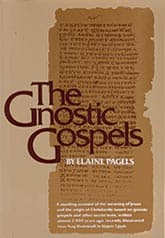 First edition, 1979
About the book
Author
Elaine Pagels, United States
First publication
c.300 BCE
Form
Nonfiction
Genres
Religion, history
Writing language
English
Length
Approx. 50,000 words
How 'secret knowledge' threatened the church
How does a book by a scholar about a murky period of religious history become a popular and critically lauded bestseller?
The book starts with a brief account of the 1945 discovery of ancient manuscripts buried in a desert graveyard in Nag Hammadi, Egypt, and the complicated story of recovering and translating them. These writings were associated with a previously little-understood group of Christians, known collectively as gnostics, who had been sidelined as heretics in the early centuries of the emerging church.
Historian Elaine Pagels was among researchers studying this literature. Her 1979 book, The Gnostic Gospels, was not the first publication about the recovered works, not even the first by Pagels. But it caught on with the modern public like no other such work, winning worldwide readership, receiving prestigious awards and selling millions of copies.
It's still considered a landmark work in popularization of scholarly research and, as an academic, Pagels is still a highly regarded authority on early Christianity.
Not that the book's argument has been wholeheartedly endorsed over the years. Though widely praised, its interpretations of the gnostic documents has also drawn controversy—largely, but not only, from traditional Christian scholars.
Why so popular?
Given the obscure subject matter of this scholarly research, you might expect The Gnostic Gospels to go on with dry summaries of the discovered texts, their dating, their conjectured origins, and what they reveal about the writers' beliefs and practices.
And we do get some of this. But indirectly.
Pagels in this book is concerned mainly with comparing and contrasting gnostic forms of Christianity, as revealed in these unearthed documents, with the branch of Christianity that would become the mainstream religion we know today. This ends up telling us much about the founding mythologies of Christianity as a whole. Pagels delves particularly sharply into how the church grew through the suppression of challenges within its own ranks.
It had to suppress the gnostics and other supposed heretics in order to succeed as the catholic (meaning universal) church in the world at large. Although Pagels doesn't get into this, parallels could be noted with other social and political movements that begin with an enthusiastic and devoted membership, only to devolve in internecine strife over the "true" doctrine. It seems to be a law of social organization. If the movement is not completely torn apart by the inner battles, the winning sect is usually the one whose professed beliefs offer the movement its greatest chance of advancement. Ideas can help or hinder practical success.
Here are some of the ideas held by various gnostics, as outlined in Pagels's interpretation of the long-buried documents:
• Christ was a spiritual being who never suffered and died on the cross, but left the human Jesus to do so.
• The resurrection was not a literal, historical event but symbolic of a spiritual experience.
• Christ taught selected followers a secret knowledge (gnosis) that would help them access the divine without going through clergy.
• Each person could find the divine within their own nature. Knowing oneself is knowing God.
• The god worshipped in the Old Testament (Yahweh) is not the supreme divinity but a demiurge, a lesser being who created the physical world and demanded obedience, without possessing or offering spiritual understanding.
• The true God contains both masculine and feminine elements.
You can see how these views were anathema to Christians who were building a male-dominated church headed by one god, one earthly leader whose succession could be traced back to the apostles, and other clergy. They were creating the hierarchy through which believers' access to divinity could be directed and the masses could be promised salvation by joining the church and accepting the passion and resurrection of Jesus Christ.
Dangerous heresies had to be squelched. Theological refutations were issued. Congregations were warned against gnostic infiltration. When the Church gained power as the official religion of the Roman Empire, gnosticism and other heresies were outlawed or marginalized. When the Bible was put together, gnostic texts (like the Gospel of Thomas, Gospel of Mary, Gospel of Truth and about three dozen others) were kept out of the canon. The rejected books were confiscated and destroyed.
As a result, most of the little we knew about the gnostics was what could be gleaned from the church's attacks on them and other heretics. What the gnostics themselves proclaimed was lost—until their writings were dug up at Nag Hammadi.
The few and the many
Commentators sometimes ponder how different the Christian world would be today if the gnostics or some other religious sect had won the battle within the early church. But this is an unlikely eventuality. Clearly, gnosticism could never succeed in winning over the majority of Christians or go on to create a powerful organization anything like the orthodox church did.
Pagels makes a lot of the expression "many are called but few are chosen" as applied to the individualistic nature of the gnostics' work. It was never designed to appeal to the masses but to reward solitary seekers of gnosis. The ideas of secret knowledge and of empowering individuals to find divinity within their own natures would seem to work against the creation of a gate-keeping clerical class. Downplaying the humanity of Christ and his painful crucifixion would remove a powerful image of redemption that human followers could understand.
Moreover, gnostic organization was unstructured and egalitarian and could not be expected to become leaders of the mainstream Christian movement which was building its catholic church along the lines of the empire, which it would eventually inherit.
Since The Gnostic Gospels was published, Pagels has been criticized by some scholars for over-generalizing the positions in the disputes between gnostic and orthodox Christians. This may or may not be a valid concern in this work of popularization, but Pagels does periodically issue caveats that she is not claiming all unorthodox or all mainstream Christians share the beliefs attributed to their sides.
She is also criticized for reading modern feminist views into the ancient gnostic texts, cherry-picking the supposedly egalitarian passages and ignoring the parts denigrating women. Again this may or may be the case. But it appears Pagels saws right in noting there was at least a strain of early feminist thinking among the gnostics that is not found in the determinedly masculinist church.
Other points could be and have been haggled over—that's the function of academia—but the value of The Gnostic Gospels remains. It represents a paradigm shift in public understanding of gnosticism and, more broadly, of the Christian church's origins, showing its early history was not as monolithic as has been thought for centuries.
— Eric
Critique • Quotes
See also:
Buy the book:
X (Twitter):
