Treasure Island
Critique • Quotes • Text • At the movies
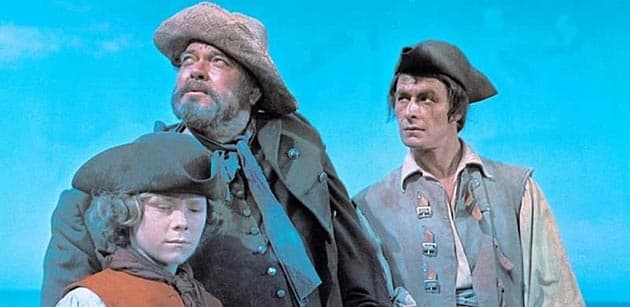
Jim (Kim Burfield), Long John (Orson Welles) and Merry (Michael Garland) seek treasure on the island.
The mumbling menace of Long John Silver
Treasure Island (1972): Film, 94 minutes; director John Hough; writers Wolf Mankowitz, Orson Welles, Bautista de la Casa, Hubert Frank, Antonio Margheriti, Gérard Vergez; featuring Orson Welles, Kim Burfield, Walter Slezak, Ángel del Pozo, Rik Battaglia, Lionel Stander, Jean Lefebvre, Michael Garland
Orson Welles—the great actor, director, writer and bane of the movie industry—was the force behind making a new adaptation of Treasure Island two decades after the iconic 1950 version. Robert Louis Stevenson's adventure novel was a lifetime favourite of his.
But, as good and faithful to the book as the film turned out, Welles is often cited as the worst thing in it.
Not that his portrayal of Long John Silver is less than scintillating. He slips past Robert Newton's own daunting rendition of the pirate by dousing the histrionic bluster. Not an "Arrrh!" passes his lips of his more subtly clever scoundrel. The coldly calculated mix of greed, murderousness and charm of his Long John draws viewers in as it does Jim Hawkins and other characters in the film, despite our reservations. Silver's highs and lows are matched by a vocal performance that ranges across the low end—a conversational tone with sudden drops into a bare rumble.
And that's where most of the criticism arises. Much of Welles's dialogue is impossible to make out. It's slurred and lazily many have complained. As if Welles were trying to emulate the Marlon Brando and James Dean method of mumbling on film but went too far. Or, less charitably, as if he were drunk.
Some of his dialogue is said to have been re-dubbed by another, uncredited actor, though it is unclear where in the film this happens, and whether this actually improves its intelligibility.
But Welles may have been purposely dipping his voice below comprehension to deliver a more quietly nasty character. His actual words were less important than the menace he conveyed by obscuring them, he may have thought. And it does in fact succeed in making his Long John a less knowable character. As he rows off to freedom at the end of the adventure, his true nature is still a mystery. Jim's niggling ambivalence toward the wicked pirate is shared by the audience.
But putting Welles's performance aside (if possible), you may find this film is after all a good representation of the famed novel. Rougher, less sentimental, than the Hollywoodized and Disneyfied previous adaptations. Probably closer to Stevenson's intentions.
Trailer for the 1972 adaptation of Treasure Island.
Most of the other major characters, starting with Jim (the little-known Kim Burfield in 1970s-style curly, long hair), are rather nondescript but their actors serve the story reasonably well. Standing out—by delightfully overacting compared to their colleagues—are Lionel Stander as the doomed Billy Bones, Walter Slezak as Squire Trelawney who can't keep as secret and, of course, Jean Lefebvre as wild and crazy Ben Gunn.
The overall production is uneven, as if hurried to completion while funding was running out. Yet there are some nice location shots and a few graphic action sequences among the generally flat scenes.
The director of record is journeyman John Hough. However, Orson Welles (yes, back to him again), who had hoped to direct Treasure Island and had a hand in the screenwriting, is said to have exerted his will upon the direction as he did in every movie he acted in. To the betterment or worsening of this film is anyone's guess.
— Eric
See also:
Buy the book:
X (Twitter):
