Hamlet
Critique • Quotes • At the movies
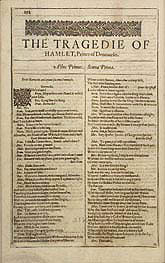 Page from First Folio, 1623
About the book
The author
William Shakespeare, England
Original title
The Tragicall Historie of Hamlet Prince of Denmarke
Written
1599–1601
First performed
1601 or 1602
First published
1603, in the First Quarto
Literary form
Play
Genre
Tragedy
Writing language
English
Author's country
England
Length
Five acts, 4,042 lines, approx. 29,000 words
The play for all our ages
Hamlet is such a famous play—so much the great drama, the one that everyone in the world can quote at least six words from—that we usually can't see how strange it is that this should be so.
Look at the plot. The prince of Denmark suspects his father, the previous king, was killed (his father's ghost told him so) by Uncle Claudius who has taken the throne—alongside his mother the queen. So he spends most of the play moaning and trying to make up his mind what to do about it.
Along the way he kills an innocent man, drives the woman who loves him to suicide, alternately berates and comes on to the queen, taunts the new king by staging a play about regicide, and escapes being murdered himself, until finally leaving the court strewn with bodies, including his own.
It's Shakespeare's longest play (if you have the edition with the full text). Very dramatic. Violent. Yes. Passionate and darkly reflective by turn. Yes. Yes. A lovely tale of power, intrigue and bloody vengeance.
For Klingons maybe. But what is it about this play that appeals so deeply to the rest of us more gentle folk?
It's difficult to get a handle on Hamlet. It's all over the place, yet somehow intensely focused. You could write an essay on any of a dozen themes found in Hamlet, but you probably couldn't sum up what the play is about. Many have tried but few of any have succeeded. The best of them seem to get hold of part of the play and run with that.
There are too many ways of looking at Hamlet, with new ways still being invented after four centuries. One of the latest academic trends, at this time of writing in the early years of the twenty-first century, is to interpret Hamlet as a coded defence of religious freedom, since it's been discovered Shakespeare himself was probably a secretly practising Catholic in officially Anglican England. This perspective on the play is sure to be argued over for a few more years—until a new one takes over the spotlight.
What we make of it
With all the intense scrutiny of the play, maybe Hamlet is about intensity itself, about the desperate, inchoate yearning inside us. So no matter how different from the prince's our own personalities and circumstances might be, we each identify with his confusion of fear and outrage. Maybe.
I don't usually don't buy the nostrum that a work of art is whatever you make of it, but Hamlet more than most plays seems open to multiple interpretations that depend on the audience's situation and expectations.
The great Albanian actor Alexander Moissi (1879–1935) played the lead role in Hamlet often over a thirty-year period and is said to have unveiled three interpretations at different stages in his life. As a young man, he portrayed Hamlet as sentimental and melancholy, suffering spiritually. As he matured, his Hamlet became a humanist. And in his later years, he played the prince as a rebel, not merely bent on revenge but standing against tyranny and hypocrisy.
Interestingly, all three of these interpretations could represent phases that adolescents go through on a daily basis. Just listen to an hour of teen popular music—rock, rap, heavy metal, whatever—and you'll hear all these stances. And more than once you'll sense the implied violent release that Shakespeare delivers at the end of Hamlet.
So I'll leave it to present and future generations to find their own interpretations of Hamlet. Perhaps, as Hamlet says, the play's the thing.
He's referring to his staged play-within-the-play as the way he'll provoke the king, but we can also take the enclosing play, Hamlet, as the thing to rouse and exorcise our own personal or social demons.
End of serious discussion on Hamlet.
Run, Hamlet, run
In case you really don't want to bother reading this disturbing this play in its full length, here's a more easily digestible summary for you. It's supposed to have appeared in a Time-Life publication in 1962 and shows how Hamlet would be written for one of the Dick-and-Jane primers that were popular for teaching children to read in those days:
See Hamlet run.
Run, Hamlet, run.
He is going to his mother's room.
"I have something to tell you mother," says Hamlet.
"Uncle Claudius is bad. He gave my father poison. Poison is not
good. I do not like poison. Do you like poison?"
"Oh, no, indeed!" says his mother. "I do not like
poison."
"Oh, there is Uncle Claudius," says Hamlet. "He is
hiding behind the curtain.
Why is he hiding behind the curtain?
Shall I stab him? What fun it would be to stab him through the
curtain."
See Hamlet draw his sword. See Hamlet stab. Stab, Hamlet, stab.
See Uncle Claudius' blood.
See Uncle Claudius' blood gushing.
Gush, blood, gush.
See Uncle Claudius fall. How funny he looks, stabbed.
Ha, ha, ha.
But it is not Uncle Claudius. It is Polonius. Polonius is Ophelia's
father.
"You are naughty, Hamlet,' says Hamlet's mother. 'You have
stabbed Polonius."
But Hamlet's mother is not cross. She is a good mother.
Hamlet loves his mother very much. Hamlet loves his mother very, very
much.
Does Hamlet love his mother a little too much?
Perhaps.
See Hamlet run. Run, Hamlet, Run.
"I am on my way to find Uncle Claudius," Hamlet says.
On the way he meets a man. "I am Laertes," says the man.
"Let us draw our swords. Let us duel."
See Hamlet and Laertes duel. See Laertes stab Hamlet. See Hamlet stab
Laertes. See Hamlet's mother drink poison. See Hamlet stab King
Claudius.
See everybody wounded and bleeding and dying and dead.
What fun they are having!
Wouldn't you like to have fun like that?
Or, in case even that is too much for you to take in, there's the still shorter version I once created for social media in 140 characters:
Methinks uncle killed dad, now ghostly. And bedded mom. Alas poor me. To be? To kill! Oops. Try again. Oops, oops. Ahhh. Goodnight. Silence.
— Eric
Critique • Quotes • At the movies
