
Othello
Critique • Quotes
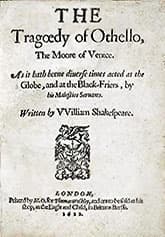 Title page, first quarto, 1622
First performance
1604
Literature form
Play
Genres
Tragedy
Writing language
English
Author's country
England
Length
Five acts, 3,551 lines, approx. 27,000 words
The outsider inside us all
Interesting thing about Othello is that it concerns a man of African heritage who is victimized in a white European society, and yet racism is never the central issue. Othello, the "Moor of Venice", is done in by Iago's ambition and by Othello's own jealousy.
Yes, students are asked to write essays on "Racism in Othello", but they need to go through the text finely to find material for such theses.
Though the title role has often been played by black actors—most notably the great civil-rights fighter Paul Robeson—the play offers no overt proclamations of humanity equivalent to the "do I not bleed" speech of Sherlock in The Merchant of Venice.
If discrimination is expressed toward Othello it is mainly because he is an outsider and not as acute to the ways of polite society. The humanity of the Moor is expressed in this play by the fact that he is prey to the same destructive human emotions as countless other characters in Shakespeare's plays.
Quickly convinced
The plot of Othello is based on a tale by the earlier Italian prose writer Giovanni Cinthio whose work also provides the original story for the comedy Measure for Measure.
Desdemona, daughter of a senator, has secretly married Othello, a Moor in the military service of Venice. Her father accuses him of having cast a spell upon her because he cannot imagine that she would willingly "fall in love with what she fear'd to look on". This would seem to imply racist attitudes, but her father and the other officials are quickly convinced by the declarations of Othello and Desdemona that they were in love and any residual opposition based on race dissipates.
Othello is then asked to lead the Venetian defenders of Cyprus against a Turkish attack. He lands on Cyprus with Desdemona, his lieutenant Cassio, and Iago, who resents having been passed over for promotion. The Turkish fleet is diverted by a storm. Iago manipulates others in the Venetian party to lead Othello to demote Cassio and then persuades Cassio to ask Desdemona to plead in his favour with Othello. At the same time Iago suggests to Othello that Cassio is Desdemona's lover. Iago arranges that Othello should see Cassio with a handkerchief Othello had given her. In a frenzy of jealousy Othello smothers Desdemona in her bed. Iago's wife however reveals Desdemona's innocence and Iago's guilt. Iago is arrested and Othello, after trying to stab Iago, kills himself.
Explaining tragedy
In an earlier era this play was considered a warning to wives to remain beyond approach—as it was to jealous husbands.
Today, frankly, I'm not sure what this play is about. One could come up with various maxims such as "appearances are deceptive" or "listen to both sides before making up your mind" (as the senators did when Othello was accused, but as he didn't when his wife was accused), or go on about the destructiveness of jealousy.
I have read critics discussing how Othello's imperfections brought him down—his lack of introspection, his impulsiveness, his lack of knowledge about Italian society, his misplaced trust in others, his failure to trust those he should. But these explanations fail to sway me. They seem to be the kind of things you can always dig up about someone after a tragedy to "explain" it. Don't they exist to some degree in all of us without murderous consequences?
But maybe this is the point.
Othello is a tale about the harm done by the irrationality that exists in man, however praiseworthy a character has been acquired. It may or may not be disastrous. It's just the human condition, which can press one to scale great heights or to fall to great depths. Given the right—or wrong—circumstances, we're all outsiders.
— Eric
Critique • Quotes
