William Shakespeare
Critique • Authorship • Works • Histories • Critics • Parodies
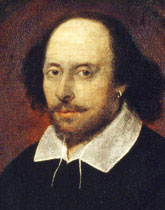
Born
Stratford-upon-Avon, England, 1564
Died
Stratford-upon-Avon, England, 1616
Publications
Plays, poems
Genres
Literary, tragedy, comedy, historical, romance, fantasy
Writing language
English
Country
England
Literature
• Richard III (c.1592)
• A Midsummer Night’s Dream (1594)
• Romeo and Juliet (c.1596)
• Henry IV, Part 1 (c.1597)
• Henry IV, Part 2 (c.1597)
• The Merchant of Venice (c.1597)
• Julius Caesar (1599)
• Henry V (c.1599)
• Hamlet (1601)
• Twelfth Night (1601–1602)
• Othello (1604)
• Macbeth (c.1606)
• King Lear (c.1606)
• Sonnets (c.1609)
• The Tempest (1611)
Plays
• The Taming of the Shrew (c.1591)
• Richard III (c.1592)
• A Midsummer Night’s Dream (1594)
• Richard II (1597)
• Romeo and Juliet (c.1596)
• Love's Labour's Lost (1597)
• Henry IV, Part 1 (1597)
• Henry IV, Part 2 (1597)
• The Merchant of Venice (c.1597)
• Much Ado About Nothing (1598–1599)
• As You Like It (1599)
• Henry V (1599)
• Julius Caesar (1599)
• Hamlet (1601)
• Twelfth Night (1601–1602)
• Measure for Measure (1604)
• Othello (1604)
• Macbeth (c.1606)
• King Lear (c.1606)
• Coriolanus (c.1603)
• The Winter's Tale (1611)
• The Tempest (1611)
• Henry VIII (1613)
Poems
• "A Fairy Song" (1594)
• "All the World's a Stage" (1594)
• "Shall I Compare Thee to a Summer's Day?" (1609)
• "When, in Disgrace with Fortune and Men's Eyes" (1609)
• "When to the Sessions of Sweet Silent Thought" (1609)
• "That Time of Year Thou Mayst in Me Behold" (1609)
• "Let Me Not to the Marriage of True Minds" (1609)
• "The Expense of Spirit in a Waste of Shame" (1609)
• "My Mistress's Eyes are Nothing Like the Sun" (1609)
Poetry Collections
• Sonnets (c.1609)
British Literature
• The Taming of the Shrew (c.1591)
• Richard III (c.1592)
• A Midsummer Night’s Dream (1594)
• Richard II (1597)
• Romeo and Juliet (c.1596)
• Henry IV, Part 1 (c.1597)
• Love's Labour's Lost (1597)
• Henry IV, Part 2 (c.1597)
• The Merchant of Venice (c.1597)
• As You Like It (1599)
• Julius Caesar (1599)
• Much And About Nothing (1599)
• Henry V (c.1599)
• Hamlet (1601)
• Twelfth Night (1601–1602)
• Measure for Measure (1604)
• Othello (1604)
• Macbeth (c.1606)
• King Lear (c.1606)
• Antony and Cleopatra (1607)
• Coriolanus (c.1608)
• Sonnets (c.1609)
• The Winter's Tale (1611)
• The Tempest (1611)
• Henry VIII (1613)
Fantasy
• The Tempest (1611)
Humour and Fantasy
• A Midsummer Night's Dream (1596)
• The Merry Wives of Windsor (1599)
Literary Fiction
• Richard III (c.1592)
• A Midsummer Night's Dream (1596)
• Romeo and Juliet (c.1596)
• Henry IV, Part 1 (1597)
• Henry IV, Part 2 (1597)
• The Merchant of Venice (c.1597)
• Julius Caesar (1599)
• Hamlet (1601)
• Twelfth Night (1601–1602)
• Othello (1604)
• Macbeth (c.1606)
• King Lear (c.1606)
• The Tempest (1611)
Romance
• Romeo and Juliet (c.1596)
• Twelfth Night (1601–1602)
Who was this greatest of all writers?
William Shakespeare was an obscure writer of Elizabethan entertainments about whom little is known....
Just kidding. But only partly.
The poet and playwright generally considered the greatest ever is also one of the least known of all literary figures. His poems and plays were created for the popular entertainment of his day with little thought to their immortality. Shakespeare did not take any steps to preserve his works past their immediate use. (Fortunately his friends did.)
With all the academic study of Shakespeare and the trappings of fine culture that have been wrapped around productions of his dramas over the centuries, we often forget what a rollicking, bawdy, violent and entertaining spectacle his plays presented to their original audiences—and, in the right hands, still do for modern audiences.
Not that his writing is not also profound and deeply moving. Like Chaucer before him and later great English writers like Henry Fielding and Charles Dickens, Shakespeare was able to engage the mind, the heart and more primitive parts of the human psyche all at once.
So first a little of what we know about Shakespeare's life and career, then we'll get into what his work was all about.
What we know of his life and career
Shakespeare was born and raised at Stratford-upon-Avon, the eldest son of a glover and a member of the local gentry. Contrary to those who claim such an ignorant country bumpkin could not write the plays attributed to him, he likely had a good education for his time, attending a local grammar school giving him a grounding in the Latin classics and in British literature and history, from which many of his dramatic plots are taken.
At eighteen, he married Anne Hathaway, with whom he had three children: Susanna (born 1583) and the twins Hamnet and Judith (born 1585). He may have worked as a schoolmaster until moving to London in the late 1880s on his own under unknown circumstances, possibly to flee poaching charges, according to one legend—or possibly running off with a travelling theatrical troupe to escape the confines of smalltown, domestic life.
Nothing is known about how he became involved in the theatre and became a writer, but he apparently was becoming known as an actor and playwright by 1592, judging by a comment from a rival then about an "upstart crow". From the early 1590s until 1611, Shakespeare wrote at least 36 plays—more if you count collaborations and plays that may have been lost—plus at least two long poems and one collection of poetry.
The plays are traditionally divided into three categories: histories (see my historically ordered notes on them), comedies and tragedies. These groupings are rough approximations however. Several of the so-called comedies are dark enough to be considered tragicomedies. The "tragedies" taking place in the ancient world are thematically similar to "histories", but the latter term is reserved for British subject matter. And some of the "histories" are quite comical.
His earliest plays to be produced in London to some acclaim are thought to be the last two or all three parts of Henry VI around 1590–1592. It is not certain whether he wrote all or just parts of these inferior histories. The lighter Comedy of Errors and Two Gentlemen of Verona were also very early plays. These first efforts may have been followed by the first part of Henry VI, written as a prequel to the other two parts, and several more early plays, including the Roman tragedy Titus Andronicus, the still-controversial comedy The Taming of the Shrew, and the durable history Richard III.
His first published works, however, were the long poems Venus and Adonis (1593) and The Rape of Lucrece (1594). His famous Sonnets were also likely begun in the early 1590s, though they were not collected and published together until 1609.
From 1594, Shakespeare was associated with a theatrical company called the Lord Chamberlain's Men, writing the great romantic tragedy Romeo and Juliet; comedies including A Midsummer Night's Dream and As You Like It, and The Merry Wives of Windsor; histories including the two parts of Henry IV; and the hard-to-classify The Merchant of Venice.
In 1596, his son Hamnet died at age eleven. It is unknown how closely Shakespeare had been in contact with his family or how deeply he was affected by the death of his only son, though the heaviness of his plays to come may not be coincidental.
In 1599 the troupe moved to a new venue, the Globe Theatre, south of the Thames River in London, likely opening with Henry V. Over the next nine years were performed the renowned tragedies Julius Caesar, Hamlet (the similarity of the name to that of Shakespeare's has been noted), Othello, King Lear, Macbeth, Antony and Cleopatra, and Coriolanus, as well as the ever-popular light comedy Twelfth Night; and several of his ambiguously dark comedies like Measure for Measure.
In 1603 when James I succeeded Elizabeth I on the British throne, Shakespeare's company gained royal patronage and became known as the King's Men. In 1608 they took over the indoor Blackfriars Theatre, for which Shakespeare wrote his last romantic comedies, probably with some collaboration from other playwrights: Pericles, Cymbeline and The Winter's Tale.
The final play written entirely by Shakespeare before retirement at the ripe old age of 47 is The Tempest in 1611.
It is thought he then returned to Stratford-on-Avon, presumably to live the life of a provincial gentleman with his surviving family in the town's second-biggest house purchased with his theatrical earnings. He does seem to have continued to spend some time in London drama circles though, helping to write Henry VIII and possibly two other plays in 1613. He died in 1616.
Centuries after the Stratfordian's death, movements have grown to claim he wasn't the author of all those plays and poems. But that's another story. And has little to do with the more important issue of what those works by him—or by someone using that name—told us.
What Shakespeare is really all about
Seven years after his death, Shakespeare's friends and colleagues published the first collected edition of his works, known as the First Folio. A dedicatory poem by playwright Ben Jonson in that book declares Shakespeare "not of an age, but for all time".
This comment has set the standard for all discussion of Shakespeare ever since. We are continually told Shakespeare is "universal". He appeals to emotions and thoughts that are part of eternal human nature. He points out universal truths. His words transcend race and culture, as shown by their translation into every language on earth and by their worldwide popularity for four centuries.
But, Shakespeare fan as I am, I must disagree. There's "universal" and there's universal.
While Shakespeare's plays do appear to reveal the hearts and minds of human beings "for all time", I believe this is because they have done so for as long as our current historical epoch has lasted. That is to say, for as long as our culture can remember. Each period thinks its insights and ideals are universal to all periods. Shakespeare's have applied much longer than most, ever since the first flowering of the capitalist era out of the decay of feudalism. They have held significance for us through the ups and downs of capitalism over hundreds of years.
However, we read his words and we take his meanings differently now from how his original audiences did in the first flush of the new era. And eventually, as social systems evolve and the people within them change, his words will come to mean less to us. His works may remain classics in the same way that the epic poetry of Homer and the plays of Sophocles are still considered classics of some interest. But his words will not always strike us to the heart as they do now. They will not always haunt our culture's thinking—just as The Iliad and Oedipus Rex are only sporadically interesting to us today.
But it's still wonderful stuff.
Shakespeare wrote at a time when the feudal, aristocratic world was being replaced by a new one based on commercial expansionism and individualism. Although he often wrote about kings and queens, these were not the God-appointed, mystically guided monarchs of ethereal thoughts and lofty morals found in medieval literature. Rather they were flesh-and-blood individuals with very human greeds and ambitions. The best of them are portrayed as ruling on behalf of the nation—the unified nation state being a recent development, replacing the fiefdoms of the Middle Ages and the city states of the ancients—rather than by divine pleasure or inherited right as previously.
Many of the questions raised in Shakespeare's works deal with the changes of mores that resulted from the historical transformation taking place.
For example, the old notion of honour—associated with chivalry and blood relations in the Middle Ages—has to be given a new meaning. Is it mere "air", as Falstaff proclaims, or something tied to taking up one's social responsibilities, as Prince Hal comes to accept?
Is there a place for compassion and forgiveness in a voracious profit-before-all-else system represented by Shylock? Do individuals have the right to choose their own happiness over traditions, as Romeo and Juliet attempt? Does a wife belong to a husband? Is wealth a guarantor of happiness? Should financial relations control familial relations, or vice versa? Do we choose our own destinies or are they fixed in the stars?
I could go on, listing the issues raised by Shakespeare that would have seemed ludicrous in older times. An 11th-century lord or peasant would not have found these to be questions even worth considering, any more than we are interested today in pondering how many angels can dance on the head of a pin.
I'm not saying Shakespeare always sided with the rising bourgeoisie on these issues or always opposed feudal values. He was dealing with conflicts that arose in a mind shaped, as the minds of most people of his time, by the stories and glories of the past, as well as excited by the forward-looking society that was forming around new economic relations and new ideas. In the exhilarating tumult, he was trying to sort out how people should act. He was seeking the constants that go beyond the immediate, changing fashions. Not always successfully, though always engagingly.
I doubt Shakespeare ever said, "In this play, I'll settle the issue of a child's obligations to a parent in the context of a society increasingly dominated by mercantilism." More likely he chose stories that he or his audience liked, and wrote them from his heart. But it is inevitable he and his audience would focus on the moral quandaries of the time, given life by the changing social conditions.
The reason Shakespeare is great isn't because he dealt with these issues when no one else did. Others certainly did. I imagine most artists of the time did to some degree. Shakespeare is great because he just wrote better than anyone else on these matters—delving more deeply, exploring more nuance, writing more eloquently and movingly than any other playwright then or since.
To put it in a single sentence, Shakespeare was writing, "Behold, the new human." Or as he put it in The Tempest, "O brave new world that has such people in't."
Today the young, new humanity he heralded is mature, if not outright old. But there resides in memory enough of youth to excite. There remains enough of our early character that we can still gain insight and comfort from Shakespeare, the sage of the old new human's youth. It is especially comforting now to think that those words and ideas from our adolescence, which once were challenging, are relevant still—appear still as universals for all time. At a time when we are casting about for new "universals" for all time.
— Eric
Critique • Authorship • Works • Histories • Critics • Parodies
