'The Machine Stops'
Critique • Quotes
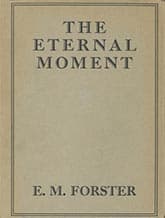 Collection including the story, first edition
About the story
Author
E.M. Forster, England
First publication
1909 in The Oxford and Cambridge Review
First book publication
1928 in collection The Eternal Moment and Other Stories
Form
Story
Genre
Science fiction, dystopian
Writing language
English
Length
Approx. 12,000 words
Here in the future
Among the seminal figures in early twentieth-century science fiction, one name stands out as an anomaly. E.M. Forster was—and is—revered as the author of such heavyweights of social conventions as A Room with a View (1908), Howards End (1910) and A Passage to India (1924). Most readers would not associate him with science fiction luminaries of the era, like Jules Verne, H.G. Wells and Hugo Gernsback.
But in addition to his literary novels, Forster also wrote fantastic stories, at least one of which—"The Machine Stops" (sometimes called a novella)—is lauded as important in the field.
Now, the science fiction community is often eager to claim some acclaimed writer with mainstream credentials as one of theirs, fitting some work or another of the writer's into the speculative fiction canon. It's a way of gaining greater credibility for the genre.
But is "The Machine Stops" really a great work of science fiction, or just an example of a literary figure slumming it?
Future shock
Those supporting the former can point to the predictive features of the story. "The Machine Stops" has been credited with foreseeing the internet, artificial intelligence, environmental collapse, homelessness and even the 2020 lockdown with people connecting to each other only through video conferencing. The parallels between the world of this story and the recent real world can't help but jump out to any reader today.
But the idea of science fiction predicting the future is faulty. You can also find some developments in the fictional world of "The Machine Stops" with no real-world parallels, at least not so far.
Still the hits in this story are stunning.
They may not have seemed so in the years after "The Machine Stops" first appeared in 1909 or soon after it was more widely published in 1928. What must have struck readers was not just the imagined technological wonders of Forster's future world, which would eventually be realized, but their negative impact on humanity.
This was something new. Forster is said to have written the story to counter the science fiction stories that depicted technology creating future utopias. "The Machine Stops" is often called (incorrectly) the first great dystopian view of a future technology-based society. Its theme has been picked up in Brave New World, Nineteen Eighty-Four and literally hundreds of works by all types of writers.
So its long-term prophetic value and its influence on the field are enough to justify considering "The Machine Stops" good science fiction. But the writing makes it great science fiction.
The human story
As a high-brow literary writer E.M. Forster is obviously no slouch, but in this story he writes more like a popular science fiction writer of the time. Mostly simple sentences. Snappy dialogue. An engaging plot.
But he also invests his prose with a certain poetical expression that reflects the fanciful mental lives of his deluded characters, contrasting with the hard mechanical system that sustains them materially—until it doesn't.
Unlike many a lesser speculative writer, Forster spends little time in exposition, never explaining how the technology works or how the society got to this point. He doesn't even go into why the Machine eventually fails. He's more interested in the human story—what happens when people grow alienated from the natural world and put their entire faith in technology.
Which is not to say Forster's text here is as easy to follow as today's latest best-seller. "The Machine Stops" was written more than a century ago after all. But it is as accessible as the stories of any of the great genre writers of that time. And more enduring than most.
— Eric
Critique • Quotes