Man's Fate
Critique • Quotes
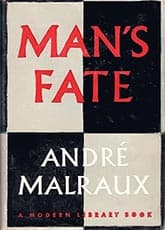 First Modern Library edition, 1934
About the book
Author
André Malraux, France
First publication
1933
Originally titled
La Condition humaine
Also known as
Storm in Shanghai and Man's Estate
Form
Novel
Genre
Literary
Writing language
French
Length
Approx. 108,000 words
Collective action, individual meaning
Despite focusing on a specific event, place and time in Chinese history—the Communist uprising in Shanghai and its brutal suppression by the Kuomintang over a few days in 1927—Man's Fate reads more like a French philosophical novel. Which it is.
Yes, it is sympathetic with the Chinese revolutionary cause and fully engaged in the real conflicts of the time.
But Andre Malraux's interest is not so much in the unfolding of historic events as in the inner struggles of the characters caught up in them, as each individual seeks to find their personal meaning within the collective action.
You could call it a classic novel of ideas with conflicting big ideas embodied in intense characters.
This begins on the first page as Chinese would-be terrorist Ch’en Ta Erh is poised, knife in hand, hesitating over the body of his first assassination target. Ch'en continues through the novel as its most twisted character, nominally a revolutionary but seeking personal salvation and ultimately self-destruction through violence.
Fraternity and freedom
Shortly we are introduced to the novel's most balanced character, the Japanese-French communist Kyo Gisors, who helped organize Shanghai's doomed insurrection. In contrast to Ch'en, his idea of revolution values fraternity among the people. He is not only willing to die for his beliefs but is willing to suffer for others.
Kyo's father, known as Old Gisors, is a former leftist professor reduced to playing a passive role in these revolution—smoking opium, dwelling on his memories, spouting quasi-spiritual aphorisms that pass for wisdom.
Kyo's German wife, the doctor May, is loyal to the same cause as her husband but also expects freedom in their personal relationship as befits revolutionaries. Unfortunately this character, lending a touch of feminism, is one of the few that seems underdeveloped. No doubt if Man's Fate were written several decades later, women would emerge more prominently from the sea of men playing roles in the struggles.
Others figures in this international cast include Katov, a Russian revolutionary working alongside Kyo, and Hemmelrich, a German phonograph-dealer who aids the communists, leading to the murder of his family by the Kuomintang.
More ambivalent figures include gambling-addicted smuggler Baron de Clappique, who helps get guns to the communists but fails to warn them of an impending massacre, and French businessman Ferral, who seems to spend more time wrapped in his sexual concerns than in his business.
All these and other characters are philosophically delineated from each other. Each taken individually is a mass of competing contradictions. This dialectical development of both plot and character should please sophisticated leftist readers. (Malraux was himself a communist-leaning intellectual at the time of writing.)
But the clash of opposites also works in pure literary terms for the larger class of readers, making Man's Fate somewhat of a page-turner. La Condition humaine (as it's titled in its original French) is often cited among the twentieth century's greatest pieces of literature. Even Ernest Hemingway lauded the novel, writing in 1935, "sometimes it is as good as Stendhal and that is something no prose writer has been in France for over fifty years."
Internal dilemmas
However, hard-core leftists may object to the rampant individualism in the novel. Like other Western novels of the time it seems more engaged with the personal obsessions and internal dilemmas the characters face than with the external revolutionary drama. Man's Fate is more about the individual's search for meaning during such times rather than in collective action itself. (Malraux reveals himself as more of a humanist and existentialist than a Marxist.)
Disturbing for a wider range of readers though may be the novel's pessimism. The uprising is crushed. Most of its heroes are killed. Personal hopes are dashed. More successful developments in the future are never hinted at.
The successes we witness are more about how characters meet death, their personal sacrifices, and their discovery of meaning in the face of life's pointlessness. Or their failure to discover meaning in the face of life's pointlessness. This is French existentialism bordering on French absurdism.
— Eric
Critique • Quotes
See also:
Buy the book:
X (Twitter):
