Riverworld
Critique • Quotes • At the movies
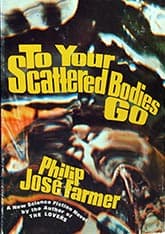 First work in the series, first edition
About the books
Author
Philip José Farmer, United States
First publications
1971–1983
Form
Novel series
Genre
Science fiction
Writing language
English
• To Your Scattered Bodies Go (1971)
• The Fabulous Riverboat (1971)
• The Dark Design (1977)
• The Magic Labyrinth (1980)
• Gods of Riverworld (1983)
Re-creation of the world
It's difficult to say exactly what constitutes the essential Riverworld series. I started reading it when only the first two books of Philip José Farmer's projected trilogy existed: To Your Scattered Bodies Go and The Fabulous Riverboat.
At the beginning of the first exhilarating novel, the explorer Richard Burton dies impaled on a spear and awakes on another world, along with everyone else who has ever lived on Earth. All humanity and near-humanity are strung along a seemingly endless river. Food is provided and anyone who dies on this world is immediately resurrected elsewhere along the river.
Burton sets on up the river to seek answers to the mysteries. Who created this world and brought everyone back to life? And why? Burton has many adventures along the way—meeting, allying and fighting with other characters, such as the Nazi Hermann Göring, the Neanderthal Kazz, and a woman named Alice, once the real-life model for Lewis Carroll's protagonist in Alice's Adventures in Wonderland.
Yes, we've gone through the looking-glass here. But it's a rational world we're in, however crazy the above scenario may sound. Our quest with Burton is more than a fantasy or science fiction search for the wizard behind the scenes. It becomes a metaphysical search as well, a search for meaning in any of our lives.
In The Fabulous Riverboat, the second great novel in the Riverworld series, the narrative focus switches to Samuel Clemens (aka Mark Twain) who teams up with England's infamous King John and a race of Vikings in a quest similar to Burton's of the first novel. In a Connecticut Yankee-style plot, Clemens uses nineteenth-century technology to build a boat equipped with weapons to fight their way along the river. Further mysteries of the Riverworld are uncovered, setting the stage for the final push for answers.
However, it became apparent to Farmer he could not wrap everything up in a third instalment of the planned trilogy. So The Dark Design brought the characters of the first two books together in various combinations, along with new personalities—like author-adventurer Jack London, cowboy actor Tom Mix, literary swordsman Cyrano de Bergerac, and others lesser known to history—in preparation for the final assault on the tower at river's end in a fourth book, The Magic Labyrinth.
Never-ending Riverworld
Here however you may be disappointed. Perhaps expectations are raised too high by this point, but the answer to the mystery is not quite satisfying and too abstract, mystical even. The Magic Labyrinth is still a good read but perhaps, as the saying goes, the journey is more important—more exciting, more mysterious—than the destination.
Gods of Riverworld gets downright silly. This fifth book seems like an afterthought, as the earthlings, having taken over the tower stronghold and solved the mystery of Riverworld, now try to uncover a mysterious renegade in the tower and mix it up with a bunch of cartoonish characters. It all seems somewhat arbitrary.
But Riverworld literature doesn't stop there. Like Tolkien's Lord of the Rings or Asimov's Foundation "trilogy", the Riverworld series has attracted legions of fans who keep demanding more and more about this imaginary world. Riverworld and Other Stories (1979) collects tales taking place on the river planet but not directly affecting the narrative of the novels. Riverworld War: The Suppressed Fiction of Philip José Farmer (1980) brings together a couple of Riverworld novellas that were left out of previous volumes. River of Eternity (1983) is Farmer's recreation of his lost story from the 1950s, "I Owe for the Flesh", upon which the novels were based.
More recently other authors have jumped in with anthologies of stories set in the same world: Tales of Riverworld (1992) and Quest to Riverworld (1993). And the Riverworld universe keeps getting more and more mixed up.
Read the first novel, by all means, and keep going as far into the series as you find involving and intriguing. You may stop after the first two—and best—novels. You may make it to the end of the tetralogy (the first four). Or you may turn into one of those crazed Riverworld fans who just can't get enough.
Whichever, I can understand.
— Eric
Critique • Quotes • At the movies
