The Foundation Trilogy
Critique • Quotes • At the movies
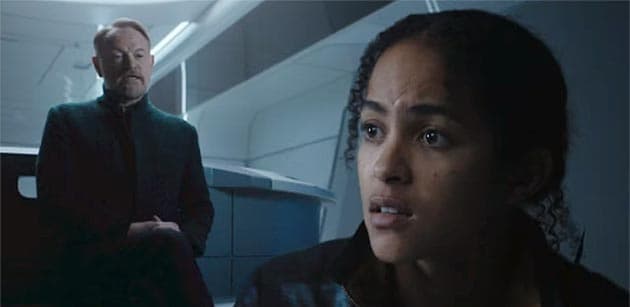
Psychohistorian Hari Seldon (Jared Harris) and Gaal Dornick (Lou Llobell) plot to protect the Foundation.
A new foundation
Foundation (2021–2025): Television series, 20 episodes of about an hour each; directors David S. Goyer, Alex Graves, Roxann Dawson, and others; writers David S. Goyer, Josh Friedman and others; featuring Jared Harris, Lee Pace, Lou Llobell, Laura Birn, Terrence Mann, Cassian Bilton, Leah Harvey, Alexander Siddig, Pilou Asbæk
How could the standout novel series of science fiction's Golden Age be adapted for film or video? Author Isaac Asimov noted his Foundation books were cobbled together from short stories spanning millennia of galactic developments with generations of characters mainly talking and working out intellectual problems. No space battles or alien confrontations suited to the large and small screen.
But what veteran SF screenwriters David S. Goyer and Josh Friedman came up with for three—and counting—seasons of the Foundation television series was brilliant. They created a visually exciting, emotionally stirring and still cerebrally engaging television series from Asimov's placid storylines.
Sure, they had to depart from some of the famous writer's core ideas, which horrified some readers, but it's hard to see the series succeeding without such alterations.
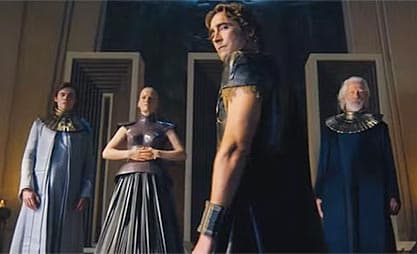
Three generations of cloned emperors and their loyal android Demerzei.
The cleverest moves may be how they got around the continual changing of characters over the galactic timescales of the novels.
Instead of a succession of different emperors overseeing the rise and decline of the Galactic Empire, the reigning dynasty represented throughout the immensely long time period by essentially the same emperor—by clones of the original emperor Cleon I, to be exact. At any given moment the empire is headed by a troika of cloned siblings: an adolescent called Brother Dawn, a man at his potent peak called Brother Day, and a senior called Brother Dusk. As time passes, Dawn grows into the next Day, Day ages into Dusk, and Dusk eventually dies to make way for another infant clone Dawn, and the cycle continues. When the Foundation series begins we're in the twelfth go-round of this cycle.
Every generation of Cleons is aided by the ageless Demerzei, one of Asimov's positronic-brained androids (an addition to the original Foundation story). Think Star Trek's Data but female and with secret feelings. She is played with great restraint and sensitivity by Finnish actress Laura Birn, especially effective when she's engaging some incarnation of Brother Day, always portrayed by American actor Lee Pace.
Pace himself is magnetic in the revolving emperor role. Like Terrence Mann as Brother Dusk and Cassian Bilton as Brother Dawn, he has to play basically the same character in each generation but with subtle differences in age, skills and personality. Genetics is not everything.
His nemesis, the psychohistorian Hari Seldon is only a slightly less formidable presence. Jared Harris, best known for his role as the strait-laced British financial officer on Mad Men, brings Asimov's reclusive Seldon into the limelight for this series. Instead of just appearing periodically as a ghostly hologram to deliver predictions, as in the books, Seldon is fleshed out as a character mysteriously taking part in the ongoing interplanetary intrigues. How this is managed is too tricky to explain succinctly but Harris makes the most of his screen time to turn Seldon into the putative star of the show.
The writers also turn Seldon's protégée from the beginning of Asimov's tale, Gaal Dornick, into a mainstay of the series, with the help of suspended animation and time jumps. Dornick is also now a woman, played by Spanish-Zimbabwean actress Lou Llobell. She turns out to be the mother of Salvor Hardin, a hero of the first book in Asimov's trilogy and also now a woman. The two end up working together, more or less.
The official trailer for the Foundation television series.
The first season of Foundation—with all these clones, holograms and time jumps—can be disconcerting, even for those familiar with the original books. A lot of complaints were heard in the show's early days. But by the second season, the confusion clears. The stories and characters draw viewers deeper into Asimov's galaxy-spanning epic.
What the author might not have appreciated, if he were still around, is how much mysticism has crept into the story. Asimov was a practitioner of "hard" science fiction and a science popularizer critical of religious and other supernatural claims. He may or may not have recognized the need to make the Foundation story more palatable for a believing public. But a skeptical viewer need not begrudge the filmmakers a little mystical licence to help bring the whole magnificent sweep of Asimov's story into existence.
And, note, the character with the strongest paranormal powers, the Mule (Danish actor Pilou Asbæk)—introduced in the third season—was created by Asimov himself in the trilogy's second volume, Foundation and Empire. Though he's much more violent and terrifying in the television serial.
Foundation is a magnificent spectacle on screen. The special effects are sumptuous and otherworldly. But the filmmakers never seem to be throwing money around to cover other deficiencies, as we sometimes see in science fiction extravaganzas. The effects are always appropriate to supporting the story and building the worlds we'd like to spend time in.
We'll see if this continues as we enter successive seasons.
— Eric
See also:
Buy the book:
Foundation; Foundation and Empire; Second Foundation (boxed set)
X (Twitter):
