Captains Courageous
Critique • Quotes
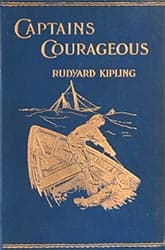 First edition, 1897
About the book
Author
Rudyard Kipling, England
Subtitle
A Story of the Grand Banks
First publication
1896, serialized in McClure's magazine
First book publication
1897 in United States
Form
Novel
Genre
Adventure
Writing language
English
Length
Approx. 53,000 words
Notable lines
The weather door of the smoking-room had been left open to the North Atlantic fog, as the big liner rolled and lifted, whistling to warn the fishing-fleet.
"That Cheyne boy's the biggest nuisance aboard," said a man in a frieze overcoat, shutting the door with a bang. "He isn't wanted here. He's too fresh."
— First lines
Like many other unfortunate young people, Harvey had never in all his life received a direct order—never, at least, without long, and sometimes tearful, explanations of the advantages of obedience and the reasons for the request.
It was the forty-fathom slumber that clears the soul and eye and heart, and sends you to breakfast ravening. They emptied a big tin dish of juicy fragments of fish—the blood-ends the cook had collected overnight. They cleaned up the plates and pans of the elder mess, who were out fishing, sliced pork for the midday meal, swabbed down the foc'sle, filled the lamps, drew coal and water for the cook, and investigated the fore-hold, where the boat's stores were stacked. It was another perfect day—soft, mild, and clear; and Harvey breathed to the very bottom of his lungs.
"Well, that one single night Penn and his folks was to the hotel Johnstown was wiped out. 'Dam bust an' flooded her, an' the houses struck adrift an' bumped into each other an' sunk. I've seen the pictures, an' they're dretful. Penn he saw his folk drowned all'n a heap 'fore he rightly knew what was comin'. His mind give out from that on. He mistrusted somethin' hed happened up to Johnstown, but for the poor life of him he couldn't remember what, an' he jest drifted araound smilin' an' wonderin'. He didn't know what he was, nor yit what he hed bin, an' thet way he run agin Uncle Salters, who was visitin' 'n Allegheny City. Ha'af my mother's folks they live scattered inside o' Pennsylvania, an' Uncle Salters he visits araound winters. Uncle Salters he kinder adopted Penn, well knowin' what his trouble wuz; an' he brought him East, an' he give him work on his farm."
Other people—summer boarders and such-like—played about in cat-boats or looked at the sea from pier-heads; but he understood things from the inside—more things than he could begin to think about.
"She was a noble packet, and one way an' another I owe her a heap—her and Dad."
"Me too," quoth Harvey Cheyne.
— Last lines
Critique • Quotes
See also:
Buy the book:
X (Twitter):
