The Adventures of Sherlock Holmes
Critique • Quotes • Text • At the movies
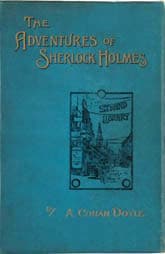 First edition
About the book
Author
Arthur Conan Doyle, England
First publication
1892
Form
Story collection
Genre
Crime, mystery
Writing language
English
Length
Twelve stories, approx. 94,000 words
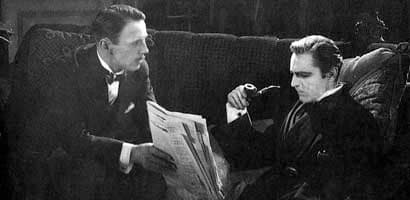
John Barrymore, right, as Holmes with Roland Young as his Watson in the 1922 silent film.
Birth of the unlikely hero
Sherlock Holmes (1922): Silent film, 85–136 minutes; director Albert Parker; writer Earle Browne, Marion Fairfax, William Gillette; featuring John Barrymore, Roland Young, Gustav von Seyffertitz, Carol Dempster
After first reading Sherlock Holmes's mysteries, you might not think them natural subjects for popular movie treatment. The main character is an abstracted cold fish, his so-called adventures are resolved through cold rationality rather than by fisticuffs or gunplay, and there's only a hint of romantic interest attached to his name. Moreover, he remains an enigma—we plumb few depths of character in studying his exploits in sixty stories and novels.
Yet, no other literary figure has nearly as numerous and diverse interpretations on screen. Actors—often among the best of their generation—seem to relish the opportunity to portray this odd specimen of humanity. From the earliest days of cinema up to the current year of writing, more than a century later, we get Sherlock Holmeses rolling out of film and television studios like clockwork.
For some reason, however definitive any interpretation may appear in its day, we the public keep wanting more Holmes.
There are very few movies actually called The Adventures of Sherlock Holmes, as that title refers to Arthur Conan Doyle's first collection of short stories about the Victorian-era detective (which is on our Greatest Literature list). However, the stories from that collection have been made into countless films and television features over the years all around the world, as have the novels and stories from Doyle's previous and subsequent publications.
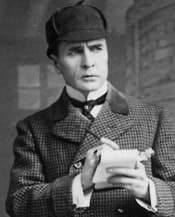
William Gillette as Holmes.
So we'll run through the various Holmes series and one-offs without worrying overly about which books they adapt—with special attention to the many attempts at The Hound of the Baskervilles, Doyle's purported masterpiece.
The first actor associated with Sherlock Holmes—and who still holds the record for appearances as the consulting detective—played him on film only once. With Arthur Conan Doyle's endorsement, American actor William Gillette rewrote Doyle's attempt at a play, called simply Sherlock Holmes, and performed it thousands of times from 1899 to 1932. Gillette introduced the deerstalker cap, the curved pipe and the phrase "Elementary, my dear fellow", which have stuck to the character as much as any features created by Doyle. He also humanized Holmes and—horrors for Sherlockian purists!—had him fall in love.
No known copy of Gillette's original silent movie of 1916 exists. However, nearly a century later a French serial made from the film was discovered in the Cinematheque Francaise archive. It has been restored and pieced together, and its French title cards translated back into English, to provide a film that's close to what Gillette created.
The first movie adaptation of Sherlock Holmes had been a 1908 Danish silent film. British thespian Ellie Norwood became best known in this era for playing Holmes in forty-five shorts and two features from 1920 to 1923—the most silver-screen appearances as the sleuth by any actor then or since.
Holmes restored
The most notable surviving entry of early Sherlockian film may be Sherlock Holmes (1922) with the great classical and film actor John Barrymore. As might be guessed, this entry is also based on Gillette's stage play, rather than directly on any one of Doyle's works.
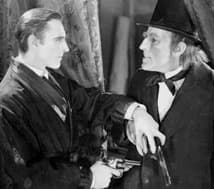
Barrymore and Seyffertitz.
In the latter twentieth century, this film, once thought lost, was rediscovered and restored, with more additions and revisions in 2001. Some sequences are still jumpy, missing a few key frames—such as the one shown in this still when Holmes (Barrymore) temporarily disarms arch villain Moriarty (Gustav von Seyffertitz). For the most part though, we get a very good idea of both the original film and the Gillette play.
The story cannibalizes a number of Holmes stories, particularly "A Scandal in Bohemia", and starts differently from the Doyle canon. Watson is an Oxford University student whose friend, a European prince, is framed for murder by a Moriarty-led gang. Watson turns to another classmate, Holmes, for help. When we first see the future detective he is wandering country lanes musing on philosophy and love. But after his first experience with criminality ends tragically, he finds his calling and devotes his life to bringing Moriarty to justice.
The film follows, sometimes confusingly, the battle of wits between the two. It ends with justice triumphant and Holmes engaged to be married. Barrymore's famous profile is perfect for Holmes, his rheumy eyes are expressive and his athletic body appropriately graceful. One wonders what a great Sherlock he might have made if we also had the benefit of his commanding voice.
Roland Young's Watson is a non-entity once the story gets rolling, but the women have more to play with. Carol Dempster, who was barely twenty-one at the time, flashes her own big eyes finely as the love interest Alice Faulkner, who has letters that could blackmail the prince—a role similar to that of Holmes's "the woman" in the stories. Future gossip columnist Hedda Hopper is similarly effective as a villainess.
Early scenes from the 1922 silent film of Sherlock Holmes starring John Barrymore.
German actor Seyffertitz establishes the model for Moriarties to come. (But is it my suspicious imagination or is he made up to look, despite his name, like a stereotypical Shylock-style Jew?) Also, watch for future Thin Man detective William Powell in his first movie role as a Moriarty henchman.
At the end, as he is led away by cuffs, Moriarty hisses (or so we imagine) at Holmes: don't think for a minute this is the end.
Alas, the two actors never meet again as rivals on screen, but the characters' continuing battles are played out in countless films to come.
— Eric
Critique • Quotes • Text • At the movies
1922, 1929–1933, 1931–1937, 1939–1946, 1954–1955, 1959–1984, 1962–1992, 1965, 1970, 1975–1988, 1976, 1979, 1982, 1984–1994, 2000–2002, 2002, 2002b, 2009–2011, 2010–2017, 2012–2019, 2015
