The Adventures of Sherlock Holmes
Critique • Quotes • Text • At the movies
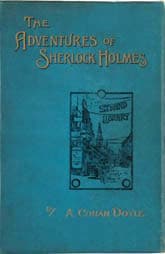 First edition
About the book
Author
Arthur Conan Doyle, England
First publication
1892
Form
Story collection
Genre
Crime, mystery
Writing language
English
Length
Twelve stories, approx. 94,000 words
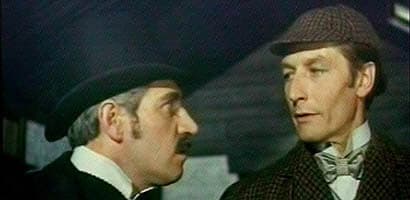
John Neville's Holmes, right, is unlovable but appreciated, supported by Donald Huston's Watson.
A study in cool
A Study in Terror (1965): Film, 95 minutes; director James Hill; writer Donald Ford, Derek Ford; featuring John Neville, Donald Houston, Anthony Quayle, Judi Dench
The 1960s squeezed in yet another Holmes, this film a one-off starring yet another classically trained actor.
A Study in Terror (1965) may be the best Sherlock Holmes film to be usually overlooked. John Neville's interpretation is seldom mentioned in the comparisons of Rathbone, Cushing, Lee, Brett et al. But the neglect is undeserved, as both the movie and the actor make interesting contributions to Holmes filmography.
John Neville in later years became better known for a five-year stint as artistic director of Canada's Stratford Shakespearean Festival, for a star turn in Terry Gilliam's The Adventures of Baron Munchausen, and for a recurring part as The Well-Manicured Man in The X-Files television show.
The latter role is most appropriate for our discussion here because, even as a younger man of about 40 years, Neville made for a rather fastidious Sherlock Holmes in A Study in Terror. Something about the actor, no matter how he tries to charm, is too neat, too cool, too delicate for us to really latch on to.
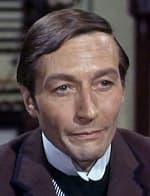
Neville's a neat Holmes.
But, if you don't need to love Holmes, Neville is very good. So good that he was afterward offered the lead in BBC's Sherlock Holmes series to replace Douglas Wilmer, though he was unable to take the role, which eventually went to Peter Cushing—whom he resembles in both physiognomy and his less-is-more acting style.
He's surrounded here by a top-rate British cast, including Donald Houston blustering about as Watson, Anthony Quayle at his most dramatic as a crusading doctor, and Judi Dench as the ingénue, decades before she became the revered Dame.
I usually disdain movie scripts that have fictional characters dealing with real historical figures. In putting Holmes on the trail of Jack the Ripper, the writers seem to be suggesting the consulting detective's fictional cases are not sensational enough—to draw viewers they need to bring in one of the most notorious and gruesome murderers in history.
What's next, having Sherlock go up against Hitler? Oh, wait, he already did that in several of Rathbone's films.
But the fears of sensationalism, encouraged by the cheesy title (which also echoes Rathbone films) are unfounded. The plot of A Study in Terror is cleverly contrived and seriously acted.
It's also photographed in brilliant, bright colour, something new for Holmes sagas in the long form.
Still the film may be most noteworthy for launching what has almost become a subgenre: the bringing together in books and movies of those two icons of the Victorian era, Sherlock and Jack. Novels in this category include Exit Sherlock Holmes (1977) by Robert Lee Hall and Michael Dibdin's The Last Sherlock Holmes Story (1979). Later video presentations featuring the Ripper case (which Arthur Conan Doyle never wrote about) include the Sherlockian film Murder by Decree (1979), the movie From Hell (2001) with a deducing and drug-addicted detective obviously based on Holmes, and several television episodes, as well as even a video game.
At this writing, A Study in Terror is not widely available, though it does occasionally show up on classic television channels. It was remastered and released on DVD in 2011, albeit with a ridiculously garish cover that seems to parody its 1960s origins. It is hoped viewers get past the silly artwork to rediscover the gem within.
— Eric
Critique • Quotes • Text • At the movies
1922, 1929–1933, 1931–1937, 1939–1946, 1954–1955, 1959–1984, 1962–1992, 1965, 1970, 1975–1988, 1976, 1979, 1982, 1984–1994, 2000–2002, 2002, 2002b, 2009–2011, 2010–2017, 2012–2019, 2015
