Captains Courageous
Critique • Quotes
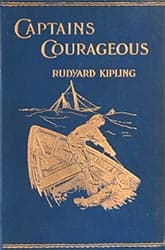 First edition, 1897
About the book
Author
Rudyard Kipling, England
Subtitle
A Story of the Grand Banks
First publication
1896, serialized in McClure's magazine
First book publication
1897 in United States
Form
Novel
Genre
Adventure
Writing language
English
Length
Approx. 53,000 words
At sea in a lost morality tale
How could Captains Courageous, once admired as one of Rudyard Kipling's most popular and inspiring adventure tales, lose favour so drastically it's practically dropped out of sight?
And is it fair?
Part of the explanation may be the decline of the author's reputation in general. Since at least the Second World War, Kipling's writings have increasingly been criticized as propaganda for the former British Empire, which has itself declined to the point of disappearing.
But this doesn't explain everything. Recently the colonialist views expressed in Kipling's works have been re-evaluated somewhat, seen as more complicated and nuanced than previously recognized. But Captains Courageous, one of Kipling's few stories originating in United States, has never regained its standing. It still clings to the lower rungs of a few modern classics lists, but barely.
At least three features of the novel prevent its wider acceptance.
Adrift in dialect
Most obviously challenging are the thick dialects employed throughout most of the story, especially during scenes aboard the fishing schooner We're Here, which pulls spoiled, rich kid Harvey Cheyne from the Atlantic Ocean, saving him from drowning. We're Here has a multicultural crew, speaking heavily accented and grammatically erratic English, rendered phonetically in the novel. Plus, they throw around nautical terms and fishing slang without explanation.
So you get exchanges like this:
"I'll lay my wage an' share 'tis more'n half play-actin' to him, an' he consates himself he's a bowld mariner. Watch his little bit av a back now!"
"That's the way we all begin," said Tom Platt. "The boys they make believe all the time till they've cheated 'emselves into bein' men, an' so till they die—pretendin' an' pretendin'. I done it on the old Ohio, I know. Stood my first watch—harbor-watch—feelin' finer'n Farragut. Dan's full o' the same kind o' notions. See 'em now, actin' to be genewine moss-backs—very hair a rope-yarn an' blood Stockholm tar."
You can usually—but not always—get the general idea of what's being said, if not specifics. It can slow you down though as you try to figure it out. You'll likely skim over some of the most difficult passages and risk finding yourself adrift in the plot that follows.
Racial stereotyping
Bits of speech that are most objectionable to many readers today though are the racial epithets, most notably the infamous N-word, used by the fishermen. This places Kipling among a group of otherwise admired authors, including Mark Twain, Joseph Conrad, John Steinbeck and William Faulkner, whose characters have uttered that term.
He might be defended on the same grounds that some critics have defended the other writers—arguing the writer himself is not racist, the writer is just authentically depicting the colloquial speech of people at a certain time and place.
It doesn't help though that in Captains Courageous the schooner's cook, the only black crew member, is variously depicted as a ridiculous figure. He seems unable to engage in conversation properly. He rolls his eyes and waves his arms in a kind of dumb show. And ultimately he is servile to the wealthy white boy. There's a reason movie adaptations have drastically rewritten or eliminated this character.
A good little robber baron
More than an adventure, Captains Courageous may be called a coming-of-age novel (a bildunsroman, if you want to get all literary about it). In that analysis, it's all about how Harvey Cheyne changes from boyhood into adulthood, how manual labour and obedience to his father—or to his captain and father figure Disko Troop—makes him a man, as the text mentions multiple times. (The quest to "be a Man, my son" seems a common theme in Kipling's work.)
But the changes happen far too easily in this novel. Too quickly after he lands on the fishing schooner, the rich brat, who's never had to lift a finger in the first fifteen years of his life and who's condescended to his working-class inferiors, transforms into a hard-working member of the crew. With only a few bumps along the way does he move from being considered a "Jonah" (bad luck omen) in the fishermen's eyes to being accepted as a trusted, productive colleague.
When after several months the boat returns to shore in America, you might think the adventure is over. But the coming-of-age story continues for what amounts to another third of the novel. Harvey's wealthy parents rush across the country on private train carriages to reunite with the son they thought had drowned. Then we get the boy, having had the most exciting experience of a lifetime among the fisherfolk, immediately giving in to their original plans for him and going to university, preparatory to following his father's footsteps into business.
For it turns out that the book's title refers both to captains on the sea like Troop and to captains of industry like Harvey's father. Kipling goes to great effort to portray Mr. Cheyne as the same kind of self-made leader among men as Troop. It's pointed out railroad magnate Cheyne once worked with his hands and he's admired by workers who can somehow sense this character-building employment in his past. Harvey's shipboard adventure is recognized by his father as a similar, necessary phase of his career, gaining him labour experience before taking his own place among captains of industry.
Remember, Captains Courageous takes place in an era when unscrupulous monopolistic practices, ruthless exploitation of workers and squeezing of consumers earned such filthy rich businessmen the title of robber barons. Kipling is fast to draw far different profiles of these figures as represented by Mr. Cheyne.
Harvey is quickly—too quickly—agreeable to falling into the life laid out for him. His former shipmates are happy for him and immediately fall into supporting roles.
It's disconcerting for a modern sensibility, especially when one is aware of the historical reality.
So, to answer the second question: yes, it is fair that Captains Courageous has fallen out of favour.
— Eric
Critique • Quotes
See also:
Buy the book:
X (Twitter):
