The Hound of the Baskervilles
Critique • Quotes • At the movies
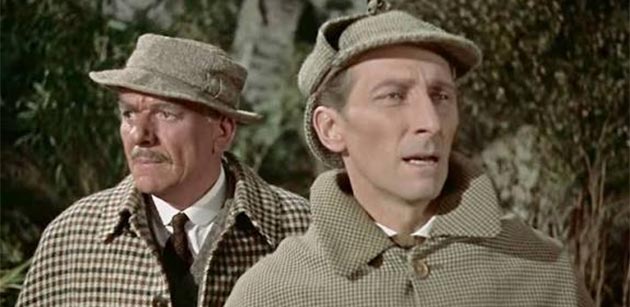
André Morell, left, and Peter Cushing bring The Hound of the Baskerviles back to the big screen.
Seriously, Sherlock
The Hound of the Baskervilles (1959): Film, 87 minutes; director Terence Fisher; writer Peter Bryan; featuring Peter Cushing, André Morell, Christopher Lee
During the period of cultural upheaval in the late 1950s and 1960s you might expect Sherlock Holmes to be perceived as a relic of a stodgy earlier age. Filmed and televised crime stories were all about gunfights and car chases, nothing like the refined intellectual labour of Sherlock Homes and his imitators.
Yet there remained a fascination with, or at least a curiosity about, Arthur Conan Doyle's detective creation. Appropriately, the most prominent Holmeses of the time were portrayed by classically trained British stage actors and veterans of British horror cinema, who took Holmes seriously—and took him into his middle and later years.
In the years after Basil Rathbone retired his magnifying glass, the most celebrated Holmes may have been Peter Cushing (best known to a younger audience as the evil Grand Moff Tarkin in Star Wars).
Not-so-scary Hound
Cushing started playing Holmes in Hammer Studio's The Hound of the Baskervilles in 1959, which co-starred his horror-film colleague Christopher Lee as Sir Henry Baskerville. The film was helmed by their talented Hammer director Terence Fisher. Together they'd all done a ripping Curse of Frankenstein two years earlier, a great Dracula the year before, and a decent version of The Mummy the same year as Hound.
Odd then that Hound, known as Doyle's darkest tale, seems too light and sunny in this remake. Perhaps because this is the first version of the classic thriller to be shot in colour. Only the dark night scenes on the moor carry the requisite mood of doom.
Cushing is not as imposing as Rathbone as the detective, being smaller and finer featured, but he possesses a flinty intelligence that works well. He takes very seriously his intention to portray Holmes honestly, bringing out his austere and prickly sides, the serial depressive of the novels—not so much as to put off his admirers but with a hint of the man's anti-social nature, missing in earlier productions.
To balance his sincerity, he has a capable and pleasantly dull Watson. André Morell has to actually carry about half the movie, as the narrative has Watson handle matters at the Baskerville home, meeting characters and unearthing clues, while Holmes skulks in the background—until his dramatic re-appearance in the case.
Lee has little to work with here as Baskerville, with scenes of mainly awkward romance and dull-witted victimization. If all your relatives had met gruesome ends and your own murder has been threatened, would you continually wander onto the moors alone at night?
Maybe people weren't ready for such a faithful take on the legendary story, for the Hammer Hound was commercially less successful than the studio's more outright horror fare.
However, this Hound of the Baskervilles has risen in Holmes fans estimation over the years and now takes its place beside the 1939 classic.
— Eric
