Sherlock Holmes series
Critique • At the movies
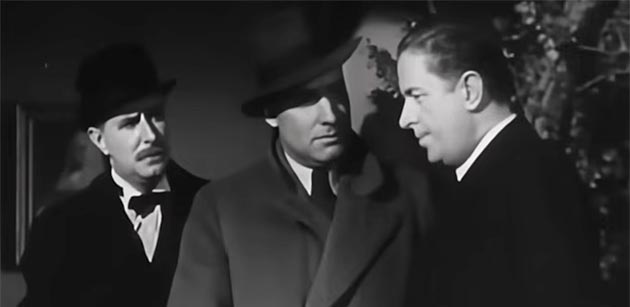
Holmes (Reginald Owen, right) explains clues to Watson, left, and Lestrade in A Study in Scarlet.
Improved Sherlock
A Study in Scarlet (1933): Film, 71 minutes; director Edwin L. Marin; writer Robert Florey; featuring Reginald Owen, Warburton Gamble, Alan Mowbray, Alan Dinehart
Reginald Owen got little screen time as the sidekick in 1932's film Sherlock Holmes, but he was encouraged to take on the main role himself the following year. Owen even helped write A Study in Scarlet (1933) in hopes of launching a popular series with himself as the detective.
Reginald Owen as Holmes.
Although it's a vast improvement, A Study in Scarlet unfortunately is not faithful enough to excite avid Sherlockians. It's not really based on the novel of that name. Opening credits only say it was "suggested" by Arthur Conan Doyle's book. The plot and subsidiary characters are entirely different, as the producers had bought rights to only the title (although I've counted at least two lines lifted almost verbatim from Doyle's text).
Owen's Holmes, operating in contemporary times like most Sherlocks of this era, is an affable and suave gentleman and his Watson (Warburton Gamble) is a stuffy, obsequious fellow, more like the English butler in old films.
The storyline is that of a decent mystery thriller of the era, involving a series of murders, an exotic femme fatale, secret passageways and a murky atmosphere. There's even a Moriarty-style villain, called (in near-parody) Merrydew.
Overall though, the film of A Study in Scarlet just doesn't feel like a Sherlock Holmes production. It feels as though it's based on a different book or story altogether with characters renamed to match those in Doyle's work. They just don't seem to speak or behave like Doyle's characters.
There's also a curious plot device that is strangely similar to the central trope in Agatha Christie's And Then There were None, a quasi-racist bit of doggerel counting down survivors as each is killed—xxxxxxx. But Christie's work would appear years afterwards, so maybe both she and this film's writer got the idea from another source?
Some have claimed the Reginald Owen film really adapts an altogether different source, namely a 1931 novel, Six hommes morts, by Belgian writer Stanislas-André Steeman, in which six men make a pact to meet and share whatever wealth they have—but begin to be killed off.
But Owen's dream failed to catch on and the projected series ended with this first instalment.
— Eric
