Sherlock Holmes series
Critique • At the movies
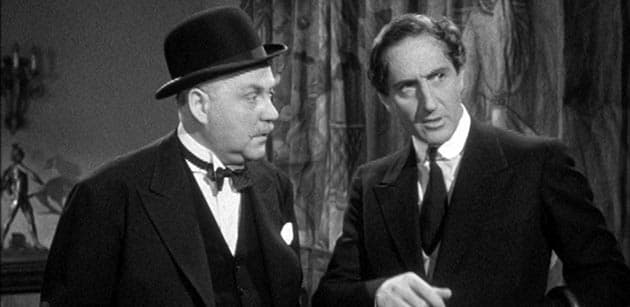
Watson (Nigel Bruce) and Holmes (Basil Rathbone) in Sherlock Holmes and the Voice of Terror.
Updated Sherlock
Sherlock Holmes (1942–1946): Twelve more films; most directed by Roy William Neill; featuring Basil Rathbone, Nigel Bruce, Mary Gordon, Dennis Hoey, Leon Atwill
Despite rejection by the movie studio that had made their first two Sherlock Holmes and Doctor Watson films, Basil Rathbone and Nigel Bruce carried on in the roles—in 220 radio dramas over the next eight years
Meanwhile, a different movie studio Universal Pictures brought them back to the screen in Sherlock Holmes and the Voice of Terror (1942). This and the successive eleven films move the sleuthing duo from the Victorian era to the 1940s to involve Holmes in more modern adventures, such as foiling Nazis in the British war effort.
1940s Rathbone as Holmes.
The Universal flicks were inexpensively produced B-movies, each usually lasting only sixty to seventy-five minutes, and often shown as parts of double bills. But they were written, acted, directed and produced better than most such flicks of their era and they proved quite popular
At times the films took on an atmosphere of American film noir which was then current, though they always remained British (despite being shot in Hollywood studios) and ended happily. Even more so than in the earlier Arthur Wontner films, the plots veered radically away from Doyle's mysteries. Most of the films had no connection to any original stories apart from the lead characters.
In Sherlock Holmes and the Secret Weapon (1943), Holmes starts in Switzerland, rescuing an inventor of a new bomb-sight from German agents. But he is soon back in London protecting the inventor from an even more devious foe than the Nazis: Professor Moriarty of course. It's a fairly intense game of intrigue played out with codes (modelled on Doyle's story of the "The Adventure of the Dancing Men"), kidnapping, secret passages, and Holmes repeatedly going under cover in disguise.
The plot is certainly more interesting at least than its previous WWII entry (Voice of Terror). Both Rathbone and Bruce shine as the detecting duo, despite the displacement in time, along with Lionel Atwill as the devious professor. But what many people remember most about this film is the patriotic (some would say jingoistic) speech Holmes makes at the end, essentially to encourage Brits to buy war bonds.
Sherlock Holmes and the Secret Weapon is the first of ten of the Rathbone-Bruce films to be helmed by veteran B-movie director Roy William Neill, who was largely responsible for the dramatic and sombre lighting effects that gave the series a film-noirish appearance.
The most interesting of the Universal films, directed by Neill, may be The Scarlet Claw (1944) in which Holmes and Watson investigate a French-Canadian village where a murderous monster is said to be roaming the marshes—shades of The Hound of the Baskervilles. Rathbone and Bruce are at their comfortable best, easily making us anxious and making us laugh by turn. The twisting plot keeps us guessing till near the end.
Trailer for The Scarlet Claw of 1944, one of the better Rathbone-Bruce later flicks.
The cheesiest of the entries may be The Woman in Green (1945), which includes elements of a couple of Doyle stories—"The Final Problem" and "The Adventure of the Empty House"—although not in any order that would make sense to a Holmes reader. Moriarty, who was supposed to be dead, orchestrates a series of murder and blackmail schemes, as well as a couple of attempts on Holmes's life. In the penultimate scene, Holmes is held captive by the villain's female accomplice who has apparently hypnotized the detective into committing suicide.
The second-last Rathbone-Bruce film, Terror by Night (1946), is not particularly terror-filled, though it does take place in that cliché of a mystery-movie locale: a train that runs all night, carrying a carriageful of suspicious-looking passengers. It is credited as being based on a Doyle story, but the only one that comes close to sharing a plot line with it is "The Disappearance of Lady Frances Carfax"—and the only connection is having jewels, ladies with similar names, and a specially made coffin play roles in it.
Holmes is assigned to guard the fabled Star of Rhodesia diamond from a clever gang of thieves and murderers he suspects are led by Colonel Sebastian Moran, Professor Moriarty's successor. There's plenty of sneaking into and out of compartments, murders, secret identities, and twists and turns of plot. Bruce nearly steals the film with Watson's particularly bumbling, but endearing, attempts to solve the case on his own. One of the faster moving and entertaining entries in the series.
The series ends with Dressed To Kill (1946), which has very faint echoes of Doyle's story "Scandal in Bohemia". The femme fatale Hilda Courtney is compared to the woman Irene Adler, the hiding place of valuables is uncovered via the artifice of a fake fire, and both Holmes and Watson refer to the earlier case. Oh, yes, and the credibility of the English state relies on Holmes's success in retrieving certain items.
Our two leads are as game as ever in this last effort, with Bruce particularly charming, but the mystery and action are pedestrian. Much relies on Holmes decoding a music box-embedded message from an imprisoned criminal to his associates. But one has to ask: why did the convict bother encoding it in such a complex fashion instead of just telling them? After all, he had to tell them about the boxes and secret message anyway. It smacks of providing Holmes one last opportunity to play with clever codes—and not very clever at that.
In all these movies Rathbone's Holmes is more an outgoing cosmopolitan than the iconoclastic calculator of Doyle's stories. Nonetheless, Rathbone's forceful performance further establishes Holmes in the public imagination during the energetic war and post-War years and made his characterization the one for all future Holmeses to beat.
Many Holmes fans however find Nigel Bruce portrays Watson as too much a buffoon to be the observant literary and medical man of the books. But Bruce's comic turn keeps Rathbone from killing the movies with high seriousness and it's great fun to watch the two leads interact. In a way, Rathbone and Bruce created enduring characters quite different from Doyle's heroes—which drives Holmes purists mad but has delighted audiences.
— Eric
