Sherlock Holmes series
Critique • At the movies
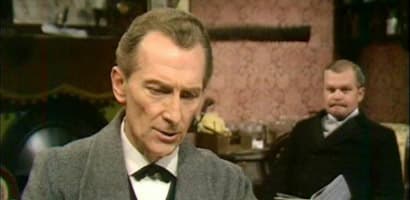
Peter Cushing brings his flinty Holmes to television, backed here by Nigel Stock as Watson.
Shrunken Sherlock
Sherlock Holmes (1964–1968): Television series, 29 episodes; featuring Douglas Wilmer (1964–1965), Peter Cushing (1968), Nigel Stock
Nearly a decade after his turn in the film of The Hound of the Baskervilles, Peter Cushing was back as the detective in the 1968 series Sherlock Holmes for British television. He got the role when he replaced classical actor Douglas Wilmer who had been been Holmes in the 1964–1965 instalment of the BBC series.
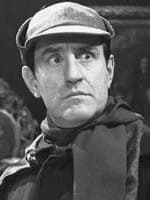
Wilmer as haughty Holmes.
Wilmer had respected Doyle's work and should be thanked for the relative faithfulness of the series instalments, which were express adaptations of the original stories. The actor, known as an interpreter of Shakespeare, ended up rewriting many of the episodes, which he considered to have been written and produced shoddily.
Wilmer was also interested in presenting the dark side of Holmes, which had been played down in most previous outings to make him more affable. The actor's long, lugubrious face and his often haughty manner as Holmes, looking down his substantial nose, helped to distance him from the audience, leaving it to the competent Nigel Stock to engage their sympathies as Watson, representative of everyman.
The series was launched in 1964 with "The Speckled Band" as the pilot. Today the black-and-white film appears somewhat stagy but it is a decent version of the story. The conclusion however, as with many of the succeeding episodes, is anticlimactic, failing to dramatize the story beyond the solving of the puzzle.
It was quite popular at the time though and twelve more episodes were produced the next year. Titles include some of the best Holmes mysteries they could get the rights to, including "The Red Headed League", "The Copper Beeches", "The Man with the Twisted Lip", "The Six Napoleons" and "The Beryl Coronet".
Despite Wilmer's misgivings, the hour-long episodes end up ranging from good to excellent as adaptations. They are generally true to the basics of the stories, though their presentations are often rearranged. For example, although Arthur Conan Doyle usually begins each case with clients calling on Holmes and Watson, most of these televised episodes begin with the on-site dramatics involving the victims and suspects and don't bring in the detectives until ten minutes in.
The 1965 season was also very popular with British viewers, but Wilmer, who fought with management, refused to return for a new one. Ten of his episodes survive in their entirety and are available, along with the pilot, on DVD, albeit in rather sloppy transfers.
This short television run, however, led to Wilmer being identified with Holmes in the minds of a generation of British fans. He also made a series of audio recordings of the stories and briefly returned as Holmes, alongside Stock as Watson, in Gene Wilder's parody The Adventure of Sherlock Holmes' Smarter Brother in 1975.
Disdainfully rational
A long search for Wilmer's successor on the TV series ended with the natural choice: Peter Cushing. As might be expected, Cushing plays Holmes in this series with an austere coldness, as if he's always mildly irritated about something. Perhaps he's annoyed with the show's producers, as he experienced the same difficulties with low production values as Wilmer had. This however also works to distinguish his Holmes as the most disdainfully rational of the lot—although he could indulge in a convivial chuckle with Watson when it is called for.
Cushing's Watson continued to be played by Nigel Stock and the two of them created another memorable duo, acting out more episodes adapted from Doyle's stories—although this time in colour and with more natural, less theatrical presentation. Television had come a long way between 1965 and 1968. Still the acting is a bit overdone (though never from Cushing or Stock) and the sound is a little hollow.
First up, is "The Hound of the Baskervilles" in two parts—Cushing's second turn as Holmes in the thriller on the moors. This one doesn't have the sweep and slick production of his 1959 film, but it is not bad for television of the time. On some points it follows Doyle's novel more closely and on other points it departs radically in the interests of compression. The best parts of the two adaptations together would make up one very long and faithful Hound of the Baskervilles.
The worst part of this production is the very abrupt and unsatisfying ending, a failing that strangely afflicts several of the other surviving episodes in the Cushing series.
Most of those episodes are taken from Doyle's first two novels and first collection of stories (The Adventures of Sherlock Holmes). Because "A Study in Scarlet"—taken from the novel in which Holmes and Watson first meet—is not the first episode in the series' order, it must proceed with the mystery as though the two are already old friends. But, for the most part, this and successive entries are quite faithful to the Doyle canon.
They proved even more popular than in the shows run three years earlier, but one season was enough for Cushing. He left the show, which never recovered. Only five of the Cushing episodes have survived (including "The Sign of Four", "The Blue Carbuncle" and "The Boscombe Valley Mystery") and are available.
— Eric
