Sherlock Holmes series
Critique • At the movies
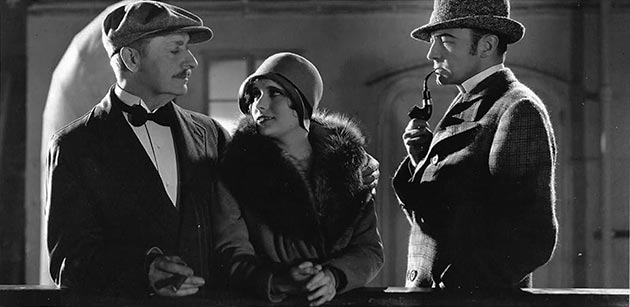
Watson (H. Reeves-Smith), Mary (Betty Lawford), Holmes (Clive Brook) in the first talking Sherlock film.
Unsound Holmes in the sound era
The Return of Sherlock Holmes (1929): Film, 71 minutes; director Basil Dean; writers Basil Dean, Garrett Fort; featuring Clive Brook, H. Reeves-Smith, Betty Lawford, Harry T. Morey
Sherlock Holmes (1932): Film, 68 minutes; director William K. Howard; writer Bertram Millhauser; featuring Clive Brook, Reginald Owen, Ernest Torrence, Howard Leeds
Clive Brook as Holmes.
As silent pictures were being replaced by talkies in the late 1920s and early 1930s, studios and lead actors competed to establish series based on the Holmes canon—a trend that has never let up. To date, more than seventy actors have played the detective in about two hundred and forty films, plus hundreds of television episodes.
From our perspective today, most of those first cinematic attempts to portray the world's most famous consulting detective in the sound era were not very successful.
Among the contending films are two starring silent-era veteran Clive Brook. In 1929 The Return of Sherlock Holmes is the first such "talkie" and in 1932 Sherlock Holmes adapts the popular William Gillette stage play (as the Barrymore silent film had done earlier).
The "Return" title may seem odd for the initial film in a projected series, but it's actually appropriate because the plot is based in part on the Arthur Conan Doyle story "The Empty House" in the third volume of Holmes stories, The Return of Sherlock Holmes. That's the story in which a supposedly dead Holmes reappears.
But the movie plot cobbles together so many bits from other stories across the Holmes canon that it all gets mixed up and diluted. Plus it's set in the then-current time of 1929, which bleeds out all the Victorian ambience of the original stories.
This is the movie that revises the Gillette-turned phrase "Elementary, my dear fellow" into "Elementary, my dear Watson", which gets picked up by later films, although neither expression ever appeared in Doyle's writing.
Playing "dear Watson" in the first flick, though, is stage actor H. Reeves-Smith. Like all actors in this early sound film, he struggles with how to perform for the evolving medium. Critics seem to be split on whether he's the film's only bright spot or he's the worst Watson ever. In any case, this was to be his last movie as he retreated back to theatre for the rest of his acting career.
Any such bad acting, however, is surpassed by that of silent-movie veteran Harry T. Morey as a cartoonish, horror-show kind of Moriarty. This would be his second-last film.
The 1929 cast is also notable for including Mary (Betty Lawford), the wife of Doctor Watson, usually neglected in screen adaptations. To no particular great effect.
Brook himself is stiff, flat and awkward, with none of the charisma exuded by the Sherlock Holmes of popular imagination. He isn't helped by stage, static direction and cinematography.
In summary, the film is a disaster for both Holmes fans and film fans in general.
A sequel of sorts
Yet Brook would go on to make another attempt at portraying the character.
Buy 1932 he seems to have learned how to act in a sound film. He speaks and moves around more naturally. He's also working with a more sensible script, adapted from the stage play.
Even so, he's not exactly the intriguing Holmes of Doyle's stories. Suffice it to show how far Brook's character has strayed from the books to note the movie starts with the sleuth—that famously sexless, confirmed bachelor—about to be married.
With Moriarty behind bars and sentenced to hang, Holmes is giving up crime-fighting—after one last case to help a friend, he tells his fiancée. Of course, Moriarty complicates the case by escaping and threatening to kill Holmes, among others.
Reginald Owen makes a decent Watson as he is a more natural movie actor than Reeves-Smith. But he's given less to do here. Instead, an insufferably precocious young boy, called Little Billy (Howard Leeds), fills in as Sherlock's sidekick for much of the plot. (The estimable Owen would recover from this outrage, shortly taking over the lead in a Sherlock Holmes film and later creating a memorable Scrooge in A Christmas Carol.)
Getting more screen time, and deservedly so, is Ernest Torrence. His Moriarty is everything you want in that villain—polished, dynamic and an intellectual match for Holmes. The repartee between the two adversaries is a highlight of this movie.
Best aspect of this movie though is its creative cinematography, at times presaging film noir with its moody, shadowy shooting and innovating special effects produced in camera.
Worst is its placing of the story in the current era and making Holmes a modern inventor. He's no longer the narrow-minded expert only in uncovering and interpreting evidence—clueless in all unrelated knowledge—but he's now a champion of science and technology.
That and the romances included in the film's story are attempts to soften the Holmes character—make him less an alien being—for the wider movie and theatre-going public.
In the course of this makeover, Sherlock Holmes actually becomes less intriguing a character. Something we'll see over and over in the century of movies to come.
— Eric
